



Crime victims urge victim-centered judicial system in prosecution reform
Jul 16, 2026, 09:56 am


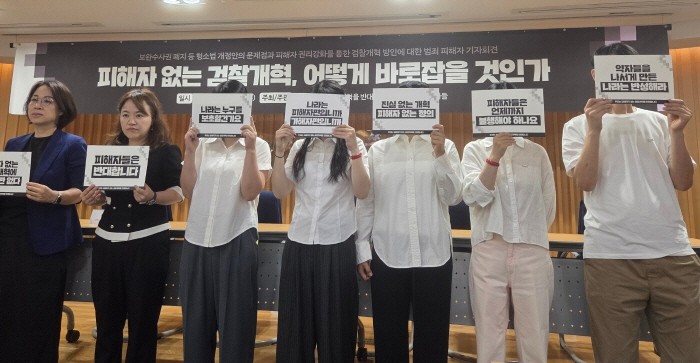 |
| A press conference titled Prosecution Reform Without Victims: How to Correct It was held at the Seoul Bar Association building in Seoul on the 15th, organized by crime victims and attorneys protesting against prosecution reform that excludes victim protection. / Photo by Reporter Son Seung-hyun |
If the prosecution's supplementary investigation rights are abolished, eliminating the remaining avenues for re-examination and correction, and if it takes months just to obtain a single supplementary inquiry, it will push already-suffering victims further into a corner.
Han Wu-ri (pseudonym), a sexual assault victim, lamented that while the names and powers of the institutions in charge of investigation and prosecution are being redesigned, discussions regarding crime victims within these procedures are completely excluded. She emphasized that reform must begin by establishing the victim as an active party in the legal process.
Victims of flawed or incomplete investigations demanded that procedures to correct such investigations, along with the victims' rights to view records and file objections, be explicitly codified in the Criminal Procedure Act.
During a press conference titled Prosecution Reform Without Victims: How to Correct It, held on the afternoon of the 15th at the Seoul Bar Association building in Seocho District, Seoul, victims expressed deep concern over proposed amendments to the Criminal Procedure Act focused on reducing or abolishing prosecution authority. They testified firsthand about the flaws in current investigative procedures and called for victim-centered judicial reforms.
The press conference was attended by seven victims and family members, including those from the Incheon Ganghwa Island abandonment bodily harm case, the Busan roundhouse kick assault case, the Sejong City gang sexual assault case, the abuse of power sexual assault case, the 75-time refusal sexual assault case, and the Seohyeon Station stabbing rampage.
Despite being direct parties or family members, they were excluded from the investigation and trial processes, forced to gather evidence themselves, and subjected to secondary victimization. While their individual cases differed, they spoke with one voice, demanding that reform be directed toward fulfilling the responsibility of correcting omitted investigations and protecting victims.
Following the testimonies of the victims and their families, discussions were held on the issues surrounding the proposed amendments and ways to improve the system to strengthen victim rights. Oh Ji-won, managing attorney at Law Firm Law & Healing, pointed out that the amendment to abolish supplementary investigation rights will only indefinitely prolong the preliminary procedures required to interview victims and suspects. She noted that even if requests for supplementary investigations are permitted, the process of bouncing cases back and forth between the police and prosecution will inevitably consume more time. The more difficult, complex, and serious a case is, the more uncertain the relief for victims becomes, Oh emphasized. She added that while a collaborative system between the prosecution and police is ideal, if political discussions prevent a return to that model, supplementary investigation rights must be recognized to some extent.
An Ji-hee, an attorney at Law Firm Hyemyung, expressed concern over the amendments focusing solely on whether to maintain supplementary investigation rights, urging that provisions guaranteeing victim rights must be included. An argued that the mandatory notification of investigation progress, the right to view and copy investigation records, and the right to object to flawed investigations must be explicitly written into the Criminal Procedure Act.
Oh Seon-hee, another attorney at Law Firm Hyemyung, also stressed the need to guarantee rights during the investigation and trial stages, including strengthening the victim's right to state their opinion. Oh remarked that whether to maintain supplementary investigation rights is not merely a matter of choosing between the prosecution and police. Instead, she emphasized that designing a system to reduce human errors that can occur during the investigative process is what truly matters. She suggested that the National Assembly must discuss various alternatives, including the scope of supplementary investigations and the comprehensive referral of all cases.
Son Seung-hyun
Most Read
-
1
Celltrion’s Omlyclo gains ground in major European..

-
2
Trump demands rates fall below 1% as Fed hikes for..

-
3
Hyundai Motor Group breaks ground on integrated st..

-
4
U.S. strikes 3 Iranian oil tankers, Iran vows reta..

-
5
Trump makes $1 trillion bet ahead of midterm elect..

-
6
Iran resumes ballistic missile production, assembl..

-
7
Samsung Electronics, Mistral AI to jointly develop..

PEOPLE







-
Address : In-Young Bldg., 34, Uisadang-daero 1-gil, Yeongdeungpo-gu, Seoul
Copyright by ASIATODAY CO., LTD. All rights resereved