



Haeinsa Temple to promote value of Tripitaka Koreana at 48th UNESCO World Heritage Committee
Jul 16, 2026, 09:50 am


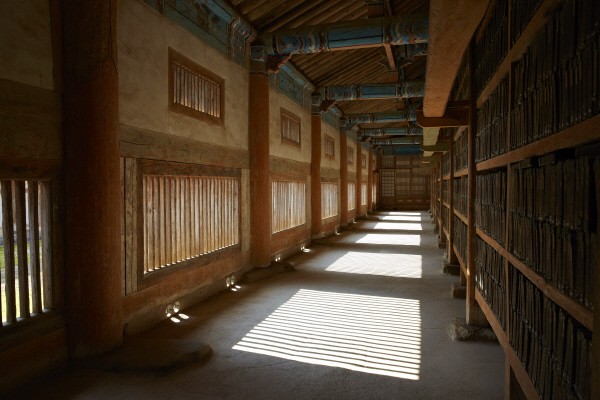 |
| The Tripitaka Koreana woodblocks stored inside the Janggyeong Panjeon depository at Haeinsa Temple. / Courtesy of Haeinsa Temple |
Haeinsa Temple in Hapcheon, Gyeongnam Province, announced on the 16th that it will operate a promotional booth during the 48th UNESCO World Heritage Committee session, which kicks off at BEXCO in Busan on the 20th. The initiative aims to introduce the historical and cultural significance of the Haeinsa Janggyeong Panjeon (depositories) and the Tripitaka Koreana (printing woodblocks) to both domestic and international visitors.
The upcoming World Heritage Committee session is the first of its kind to be hosted in South Korea, serving as the world’s largest international cultural heritage event attended by delegations from 196 World Heritage Convention member states alongside various global experts.
Haeinsa will set up its special exhibition and hands-on programs within the K-Heritage House (Korea Pavilion), a central hub showcasing Korean cultural assets. The Janggyeong Panjeon and the Tripitaka Koreana represent a globally unique case where a structure (the depository) and its contents (the woodblocks) are individually inscribed as a UNESCO World Heritage Site and a Memory of the World Register within a single location. Through this exhibition, Haeinsa intends to widely promote the Outstanding Universal Value (OUV) of these dual heritages.
The exhibition space will feature a precise 1:30 scale model of the Janggyeong Panjeon shelves alongside approximately 370 replica woodblocks, allowing visitors to grasp the physical structure of the depositories and the massive scale of the Tripitaka at a single glance. In addition, Haeinsa's ongoing project to carve additional Buddhist scriptures will be introduced through promotional materials and videos to highlight the contemporary meaning of preserving traditional carving techniques. Demonstrations by master carvers (Gakjajang) from Haeinsa’s Janggyeong Dogam Carving School will vividly present the manufacturing principles of the woodblocks and the excellence of traditional woodblock printing, raising awareness about the preservation of documentary heritage. Newly produced woodblocks from the school will also be on display to emphasize that this remains a living heritage.
On-site programs will feature monastics and demonstrators dressed in traditional Goryeo Dynasty attire performing Ingyeong (the traditional woodblock printing process), with hands-on participation open to visitors. Participants can take their completed prints home as souvenirs tied with five-colored threads, offering them a tactile experience of their ancestors' sophisticated printing culture.
Furthermore, a virtual reality (VR) zone equipped with high-definition videos and motion chairs will allow visitors to embark on a realistic journey starting from Hongryu-dong Valley, passing through Haeinsa Temple, and entering the inner chambers of the Janggyeong Panjeon. Through these multifaceted exhibitions, Haeinsa aims to demonstrate that the Tripitaka Koreana and Janggyeong Panjeon are not static relics of the past, but living heritages actively sustained today through spiritual practice, education, and the transmission of traditional techniques.
The Tripitaka Koreana is a shared heritage of humanity embodying the desperate aspirations and wisdom of the Goryeo people, a Haeinsa representative remarked. We hope this World Heritage Committee session will serve as an opportunity for more domestic and international visitors to personally experience the World Heritage value of Haeinsa and the profound depth of Buddhist culture.
Hwang Eui-joong
Most Read
-
1
Celltrion’s Omlyclo gains ground in major European..

-
2
Trump demands rates fall below 1% as Fed hikes for..

-
3
Hyundai Motor Group breaks ground on integrated st..

-
4
U.S. strikes 3 Iranian oil tankers, Iran vows reta..

-
5
Trump makes $1 trillion bet ahead of midterm elect..

-
6
Iran resumes ballistic missile production, assembl..

-
7
Samsung Electronics, Mistral AI to jointly develop..

PEOPLE







-
Address : In-Young Bldg., 34, Uisadang-daero 1-gil, Yeongdeungpo-gu, Seoul
Copyright by ASIATODAY CO., LTD. All rights resereved