



Unemployment benefit floor threatens to overshoot ceiling again
Jul 16, 2026, 09:42 am


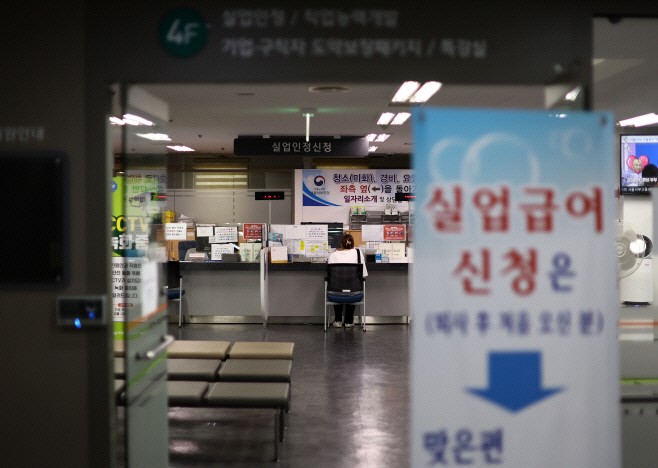 |
| A view of the Seoul Employment and Welfare Plus Center in Mapo District, Seoul. / Yonhap |
The minimum daily rate for unemployment benefits is set to exceed the current maximum rate following next year’s minimum wage increase. Although the government raised the ceiling this year to resolve the gap reversal, another readjustment has become inevitable just one year later.
Under the Employment Insurance Act on the 15th, applying the 2027 minimum wage of 10,700 won sets the minimum daily unemployment benefit at 68,480 won, which is 380 won higher than the current maximum of 68,100 won. The Minimum Wage Commission resolved the previous day to set the 2027 minimum wage at 10,700 won per hour, a 3.7 percent increase of 380 won from this year’s 10,320 won.
Unemployment benefits are paid at 60 percent of a worker's average wage before leaving their job. However, if the calculated amount falls below the floor, the benefit defaults to 80 percent of the minimum wage multiplied by daily working hours. Calculated based on 30 days per month, next year's minimum monthly unemployment benefit will reach 2,054,400 won, outstripping the maximum limit of 2,043,000 won by 11,400 won, effectively rendering the ceiling system meaningless.
This reversal occurs because the lower limit is automatically linked to the minimum wage, whereas the upper limit is adjusted separately through amendments to enforcement decrees. Last year, when the 2026 minimum wage hike was decided, the government anticipated that the benefit floor would exceed the ceiling for the first time in a decade, prompting them to raise the daily maximum from 66,000 won to 68,100 won. However, with the floor set to overtake it again just a year after the adjustment, further revisions are now necessary.
Consequently, the Ministry of Employment and Labor is expected to readjust next year's unemployment benefit standards. During last year's adjustment, the government had raised the ceiling to align with the rising floor.
The rising benefit floor is projected to add further financial pressure to the employment insurance fund, which is already suffering from deficits. According to the Ministry of Employment and Labor's settlement report for the 2025 fiscal year, payouts from the job seekers' allowance account reached a record high of 17.4833 trillion won last year. The overall employment insurance fund recorded a deficit of 592 billion won, with the actual reserves excluding borrowings from the Public Capital Management Fund remaining at a mere 79.6 billion won. Looking solely at the unemployment benefit account, the actual reserves stand at a deficit of 5.9933 trillion won.
The Ministry of Employment and Labor has been running a task force for employment insurance system reform since last November to review adjustments to the benefit floor, separate maternity leave benefits from the fund, and restructure premium rates, but concrete measures have yet to be introduced. "We will conduct discussions to prevent a reversal between the upper and lower limits," a ministry official said. "As there are various approaches available, we will consult with labor and management to review fundamental solutions."
Kim Nam-hyung
Most Read
-
1
Celltrion’s Omlyclo gains ground in major European..

-
2
Trump demands rates fall below 1% as Fed hikes for..

-
3
Hyundai Motor Group breaks ground on integrated st..

-
4
U.S. strikes 3 Iranian oil tankers, Iran vows reta..

-
5
Trump makes $1 trillion bet ahead of midterm elect..

-
6
Iran resumes ballistic missile production, assembl..

-
7
Samsung Electronics, Mistral AI to jointly develop..

PEOPLE







-
Address : In-Young Bldg., 34, Uisadang-daero 1-gil, Yeongdeungpo-gu, Seoul
Copyright by ASIATODAY CO., LTD. All rights resereved