



KCTU launches general strike of 10,000 workers
Jul 16, 2026, 09:40 am


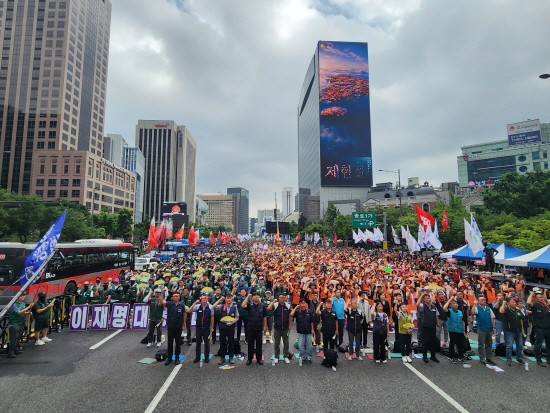 |
| The Korean Confederation of Trade Unions holds the "First Year of Principal Employer Bargaining, Breakthrough in Trans-enterprise Bargaining! Securing Basic Labor Rights for All Workers! KCTU July 15 General Strike Rally" in front of Donghwa Duty Free Shop in Jongno District, Seoul, on the 15th. / Photo by Reporter Kim Hong-chan |
The Korean Confederation of Trade Unions held a general strike rally on the 15th, urging principal employers to participate in collective bargaining. This marks the first large-scale general strike organized by the confederation since the revised Trade Union Act, commonly known as the Yellow Envelope Act, went into effect on March 10.
According to the union, approximately 10,000 members gathered for the rally in front of the Donghwa Duty Free Shop in Jongno District, Seoul, while over 100,000 workers nationwide participated in the walkout. Rally participants held pickets demanding immediate talks with President Lee Jae-myung and the fulfillment of presidential pledges to uphold the Constitution, while waving fans with the slogan "Secure Principal Employer Bargaining."
The confederation argued that while the revised Trade Union Act was introduced to correct the abnormal employment structure where principal employers use subcontracted workers but transfer all employment responsibilities to subcontractors, its purpose has been distorted, turning it into a government-controlled system where bargaining can only occur with administrative approval. Under the revised law, subcontracted workers have been stuck in bargaining procedures for four months, and the government and local authorities are denying their status as employers through their own interpretations of the law.
"Since the revised Trade Union Act took effect, numerous subcontracted, non-regular workers have demanded negotiations, but principal employers are still solely focused on evading responsibility," KCTU President Yang Kyoung-soo said. "The Lee Jae-myung administration must scrap the enforcement decrees and administrative guidelines that have become means to evade principal employer bargaining, and punish employers who refuse to negotiate."
There were also demands for the government to lead by example as a model employer. Lee Young-hoon, head of the emergency committee of the Korean Federation of Democratic Public Service and Healthcare Workers' Unions, pointed out that out of more than 440 bargaining requests made since the law took effect, 45 percent were in the public sector. He criticized the administration, stating that it is a contradictory behavior for the Lee Jae-myung administration, which pledged to fulfill its responsibility as a model employer, to deny its own status as an employer.
Affiliated organizations under the confederation also conducted industry-specific strikes and preliminary rallies across the nation. The Korean Metal Workers' Union held a four-hour strike involving 79,000 workers at various workplaces. The National Care Workers' Union designated the day as a "day of pause" and suspended operations. The Hyundai Motor branch continued its partial strike for the third consecutive day since the 13th, with shifts leaving work two hours early. General strike rallies also took place in various regional headquarters of the confederation, including Jeju and Gyeongbuk.
Kim Hong-chan
Most Read
-
1
Celltrion nears additional contract with major U.S..

-
2
Putin proposes trilateral U.S.-China-Russia summit..

-
3
U.S. weighs dropping MOAB, world's most powerful n..

-
4
"Aren't those foreigners on welfare?": M..

-
5
Attention centers on APEC for possible Trump-Xi-Pu..

-
6
Saudi Arabia, Iran hold first diplomatic talks to..

-
7
China tightens grip on boosting domestic demand an..

PEOPLE





-
Address : In-Young Bldg., 34, Uisadang-daero 1-gil, Yeongdeungpo-gu, Seoul
Copyright by ASIATODAY CO., LTD. All rights resereved