



Lee bets on property town halls to win back Seoul and youth voters
Jul 13, 2026, 09:18 am


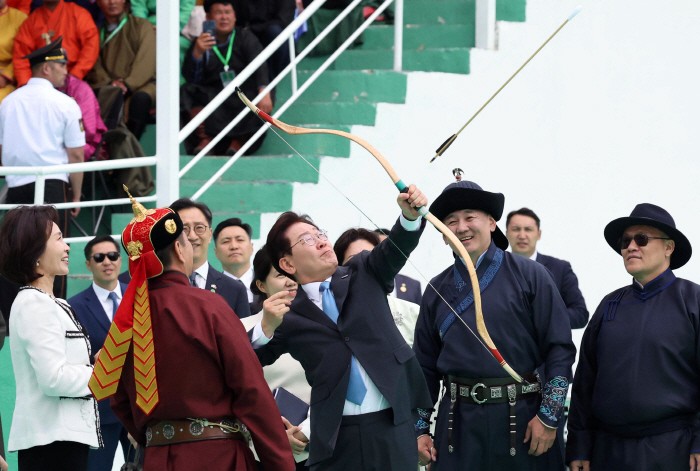 |
| President Lee Jae-myung, currently on a state visit to Mongolia, shoots a traditional bow at the Naadam festival grounds in Ulaanbaatar on July 11 (local time) as First Lady Kim Hye-kyung, Mongolian President Ukhnaa Khurelsukh, and First Lady Luvsandorj Bolortsetseg look on. / Photo by Yonhap News |
President Lee Jae-myung will personally host a live public forum on July 23 to shape the administration's direction on property taxes, housing supply, and mortgage regulations. The unprecedented move is seen as a major political gamble to soothe growing public discontent following a triple surge in house prices, jeonse (lump-sum deposits), and monthly rents, compounded by tighter lending restrictions.
It is highly unusual for a sitting president to openly debate housing issues with experts and citizens to chart policy. The presidential office appears to be leveraging this unconventional approach to break through the political deadlock, particularly as younger generations and residents in the Seoul metropolitan area voice mounting frustration over the increasingly out-of-reach housing market.
Analysts note that President Lee’s shift to a listening posture—a departure from his past confidence when he remarked that fixing the housing market would be easier than cleaning up valley streams—signals the severity of the current market conditions and an urgent need for policy adjustments.
According to the presidential office on July 12, a series of preliminary public forums will be held by key government bodies to gather expert and public feedback before the main event. The Ministry of Land, Infrastructure and Transport will lead discussions on supply on July 14, followed by the Financial Services Commission on finance on July 15, and the Ministry of Finance and Economy on taxation on July 16.
On July 10, President Lee outlined seven key agenda items on X (formerly Twitter) to guide the upcoming debates. The list includes determining appropriate holding tax levels, distinguishing primary residences from investment properties, setting thresholds for high-value luxury homes subject to higher taxes, and deciding how property tax revenues should be allocated. Market observers interpreted the post as a signal that the administration may tighten holding taxes on high-end luxury properties.
However, Presidential Chief of Staff for Policy Kim Yong-bum clarified on July 10 that while the government will adhere to public interest principles such as housing stability and tax fairness, it remains open to diverse viewpoints on holding taxes. Regarding potential moves to ease mortgage regulations for young adults, Kim stated that a final decision would be reached during the upcoming forum.
Seoul Mayor Oh Se-hoon weighed in on Facebook the same day, urging that the forum prioritize the real-world hardships citizens face daily. He expressed hope that the event would accurately capture the desperate voices of the public and serve as a starting point for tangible policy solutions.
Meanwhile, industry experts remain cautious about the forum's format. A real estate analyst noted that the event's credibility hinges on how well it includes dissenting voices and those directly impacted by regulations, warning that if it merely justifies tax hikes or targets specific demographics, it risk functioning as a public relations exercise rather than a genuine policy pivot.
Hong Sun-mi
Most Read
-
1
Celltrion nears additional contract with major U.S..

-
2
Putin proposes trilateral U.S.-China-Russia summit..

-
3
U.S. weighs dropping MOAB, world's most powerful n..

-
4
"Aren't those foreigners on welfare?": M..

-
5
Attention centers on APEC for possible Trump-Xi-Pu..

-
6
Saudi Arabia, Iran hold first diplomatic talks to..

-
7
China tightens grip on boosting domestic demand an..

PEOPLE







-
Address : In-Young Bldg., 34, Uisadang-daero 1-gil, Yeongdeungpo-gu, Seoul
Copyright by ASIATODAY CO., LTD. All rights resereved