



Japan to build AI data centers powered by nuclear energy
Jul 10, 2026, 04:49 pm


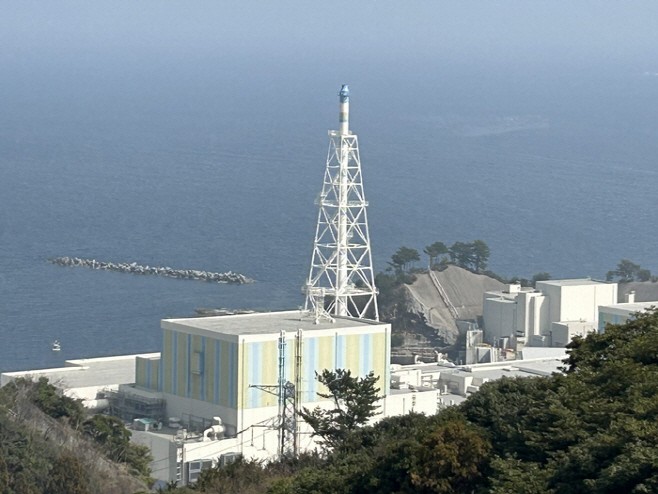 |
| The Shimane Nuclear Power Plant operated by Chugoku Electric Power Company in Japan. / Photo by Chugoku Electric Power Company |
The battleground of the AI and semiconductor race is shifting toward securing power. In Japan, local governments hosting nuclear power plants are leveraging the stable power supply from these facilities to attract Artificial Intelligence (AI) data centers. With the Japanese government completely reversing its phase-out policy to embrace the "maximum utilization" of nuclear energy, the strategy of clustering local industrial complexes with decarbonized energy sources to draw high-tech industries is becoming a reality. This case demonstrates that it has become impossible to discuss the AI and semiconductor industries without factoring in power demand.
The Yomiuri Shimbun reported on July 10 that Matsue City is creating an industrial complex centered on AI data centers by utilizing electricity from Chugoku Electric Power Company's Shimane Nuclear Power Plant. Aiming for operations to begin in fiscal year 2031, Matsue City plans to court businesses to promote local industry. The Shimane plant is the only nuclear facility in Japan located in a prefectural capital; its Unit 2 was restarted in December 2024, and Unit 3, currently under construction, aims to go online by fiscal year 2030.
The proposed site for the industrial complex spans 10.6 hectares of city-owned land in the Nakao district in northern Matsue. City officials determined that nuclear power is highly suited for data centers, which consume massive amounts of electricity stably around the clock. Nuclear energy is regaining attention as a critical infrastructure for AI data centers, given that it emits no carbon dioxide during generation and is independent of weather conditions or time of day.
Matsue City intends to start selling lots in the industrial complex from fiscal year 2027 to attract data center-related enterprises in sectors such as telecommunications and construction. Tenant companies will receive financial support equivalent to their property tax for three years, along with subsidies covering roughly 40% of their electricity bills for eight years. SoftBank will also collaborate on setting up the telecommunications network. Furthermore, the city plans to drive academia-industry-government R&D projects leveraging the data centers in partnership with Shimane Prefecture and Shimane University.
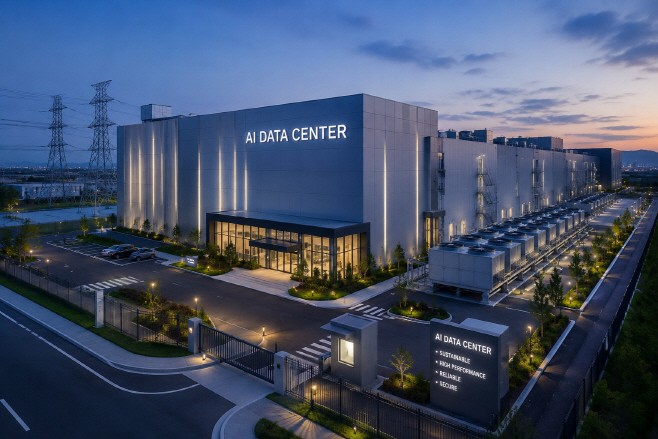 |
| AI data centers require large-scale servers and cooling facilities to operate 24 hours a day, making a stable power supply a critical piece of infrastructure. This image conceptually illustrates an AI data center. / AI-generated image |
Shift in nuclear plant locations: From compensation to industrial strategy
Behind this shift lies a pivotal turnaround in the Japanese government's energy policy. In the 7th Strategic Energy Plan approved by the Cabinet in February last year, the government virtually erased its previous stance of reducing reliance on nuclear energy, explicitly stating the "maximum utilization" of nuclear power plants. This summer, the Ministry of Economy, Trade and Industry plans to designate "GX (Green Transformation) Strategic Regions" to create new industrial clusters powered by decarbonized energy sources. Should Matsue City be selected for this program, the national government could subsidize up to half of the capital investment costs for data centers and factories.
Similar moves are spreading to other municipalities hosting nuclear power facilities. Obama City in Fukui Prefecture, located near Kansai Electric Power Company's Mihama, Oi, and Takahama nuclear plants, is developing an industrial complex with the goal of selling lots in fiscal year 2028, aiming to attract high-tech sectors like semiconductors. Kashiwazaki City in Niigata Prefecture, home to Tokyo Electric Power Company's Kashiwazaki-Kariwa nuclear plant, is also considering a GX industrial complex, targeting company move-ins by the end of 2030. Discussions are also underway to provide financial support to ensure companies can utilize nuclear power at lower rates.
The Matsue City initiative illustrates that the policy focus for nuclear plant host regions is expanding beyond traditional safety measures and local compensation toward industrial attraction and power utilization. AI data centers and semiconductor factories are prime examples of facilities requiring a continuous, large-capacity power supply 24 hours a day. As the Japanese government simultaneously pushes for nuclear restarts and the designation of GX strategic regions, local governments hosting nuclear plants have begun pitching their power supply capabilities as a prime asset for attracting high-tech industries.
In the race to court the AI and semiconductor industries, power supply planning is emerging as a critical variable alongside land, subsidies, and workforce. Independent of the ongoing debates surrounding nuclear power, the case of Matsue City demonstrates that securing a stable energy source and linking it with industrial complexes has become a key challenge for local governments worldwide in their high-tech zoning policies.
Choi Young-jae
Most Read
-
1
Celltrion nears additional contract with major U.S..

-
2
Putin proposes trilateral U.S.-China-Russia summit..

-
3
U.S. weighs dropping MOAB, world's most powerful n..

-
4
"Aren't those foreigners on welfare?": M..

-
5
Attention centers on APEC for possible Trump-Xi-Pu..

-
6
Saudi Arabia, Iran hold first diplomatic talks to..

-
7
Saudi airport in Riyadh struck again, leaving at l..

PEOPLE






-
Address : In-Young Bldg., 34, Uisadang-daero 1-gil, Yeongdeungpo-gu, Seoul
Copyright by ASIATODAY CO., LTD. All rights resereved