



Ex-President Yoon's 7-year prison term finalized for obstructing arrest
Jul 10, 2026, 09:28 am


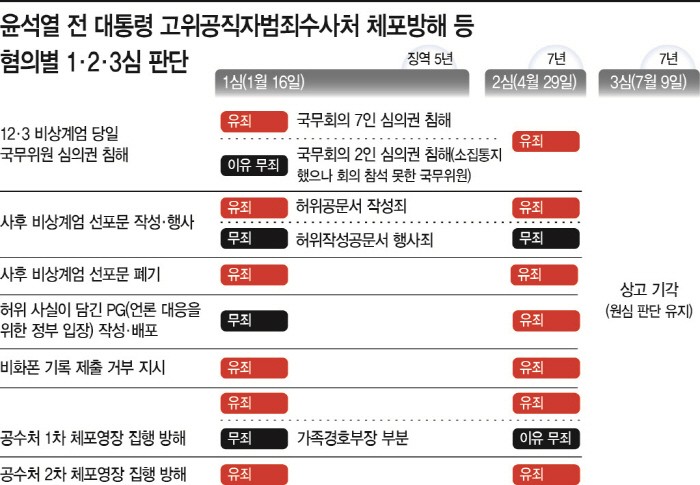 |
Former President Yoon Suk-yeol has been handed a final 7-year prison sentence for infringing upon the deliberation rights of cabinet members during the December 3 martial law declaration and subsequently obstructing the execution of an arrest warrant by the Corruption Investigation Office for High-ranking Officials (CIO). This marks the Supreme Court’s first ruling on the former president, coming 583 days after the declaration of martial law.
The Supreme Court’s 3rd Division, led by Presiding Justice Lee Heung-goo and Justice Lee Sook-yeon, finalized the lower court's sentence of 7 years in prison for Yoon, who was indicted on charges including special obstruction of official duties and abuse of official power. The top court dismissed all appeals submitted by both Yoon and the special counsel team led by Cho Eun-seok.
The ruling was broadcast live nationwide, marking the first time a Supreme Court petty chamber verdict has been televised. Yoon did not appear in the courtroom, as defendants are not required to attend Supreme Court sentencing sessions. Instead, he attended an appellate trial concerning insurrection leadership charges at the Seoul High Court on the same day.
The Supreme Court upheld the CIO’s authority to investigate Yoon for the crime of leading an insurrection. The court rejected the defense's argument that the CIO lacked the authority to launch investigations into abuse of power or connected insurrection charges due to the presidential immunity from criminal prosecution stipulated under Article 84 of the Constitution.
"The presidential immunity from prosecution under Article 84 of the Constitution cannot be interpreted as a total ban on investigations," the Supreme Court ruled. "It is reasonable to conclude that investigations are permissible as long as they do not disrupt the performance of presidential duties or undermine the status of the head of state." The court added that the direct relevance under the CIO Act stands, given that the abuse of power charges and the underlying facts share the same background and overlapping evidence.
Regarding the defense's claim that the CIO’s execution of a search warrant was unlawful due to the Presidential Security Service chief's refusal to grant consent, the court ruled, "The refusal was improper because the head of the security service failed to provide specific reasons for denying the execution, and there was no proven risk of harming grave national interests." In other words, the execution of the warrant was deemed lawful. The court also dismissed other legal arguments raised in the appeals by both the special counsel and the defense, finding no misunderstanding of legal principles.
Beyond encroaching on cabinet members' deliberation rights and blocking the execution of the CIO's arrest warrant, Yoon faced charges of retroactively fabricating and destroying the martial law declaration document, ordering the deletion of call logs from secure phones, and instructing officials to draft and distribute a press guidance containing false information to foreign media. Yoon was initially sentenced to 5 years in prison by a district court, but the term was increased to 7 years in the appellate trial as rulings on some charges were overturned.
Immediately after the verdict, Yoon’s legal team stated, "We respect the Supreme Court’s decision," but expressed deep regret that the highest court concluded such a critical case without sufficient deliberation from the perspective of the rule of law and the warrant principle. The team added, "To protect constitutional rights, we plan to contest the unconstitutionality of this ruling through constitutional adjudication procedures, such as a constitutional complaint against a judicial decision."
Son Seung-hyun
Most Read
-
1
Celltrion’s Omlyclo gains ground in major European..

-
2
Trump demands rates fall below 1% as Fed hikes for..

-
3
Hyundai Motor Group breaks ground on integrated st..

-
4
U.S. strikes 3 Iranian oil tankers, Iran vows reta..

-
5
Trump makes $1 trillion bet ahead of midterm elect..

-
6
Iran resumes ballistic missile production, assembl..

-
7
Samsung Electronics, Mistral AI to jointly develop..

PEOPLE






-
Address : In-Young Bldg., 34, Uisadang-daero 1-gil, Yeongdeungpo-gu, Seoul
Copyright by ASIATODAY CO., LTD. All rights resereved