



Labor and management narrow minimum wage gap to 690 won
Jul 10, 2026, 09:24 am


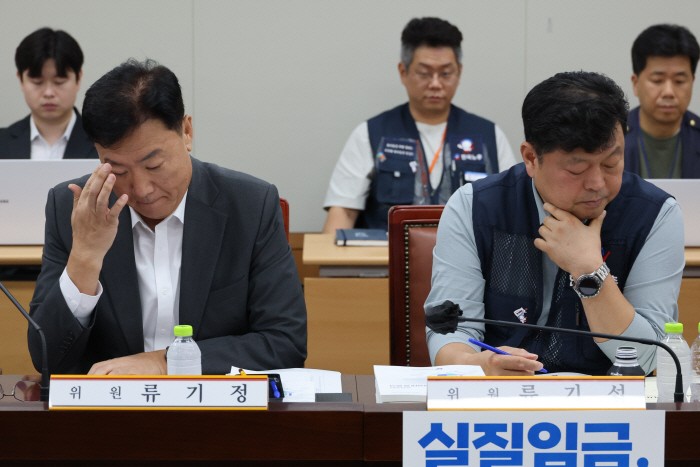 |
| Ryu Ki-jung, senior managing director of the Korea Enterprises Federation (left), and Ryu Ki-seop, secretary general of the Federation of Korean Trade Unions, listen with grim expressions to remarks by Lee Mi-sun, vice chair of the Korean Confederation of Trade Unions, during the 13th plenary session of the Minimum Wage Commission held at the Government Complex Sejong on July 9. / Courtesy of Yonhap News |
Labor and management narrowed the hourly gap for the upcoming minimum wage to 690 won, yet failed to reach a final agreement. Amid lingering differences over the rate of increase, final-stage negotiations hit a snag as two employer commissioners representing small business owners walked out of the meeting in protest against submitting a further revised proposal.
The Minimum Wage Commission convened its 13th plenary session at the Government Complex Sejong on July 9 to deliberate on the minimum wage level to be applied for 2027.
During the meeting, labor and management sequentially put forward their 7th, 8th, and 9th revised proposals. In the 7th revision, labor proposed 11,350 won, a 10.0% increase from the current minimum wage of 10,320 won, while management countered with 10,490 won, a 1.6% increase. This narrowed the gap from 990 won in the 6th revision to 860 won. In the 8th round, labor adjusted its figure to 11,250 won (a 9.0% hike) and management to 10,520 won (a 1.9% hike), bringing the gap down to 730 won.
By the 9th revised proposal, labor suggested 11,220 won and management proposed 10,530 won. Compared to the current rate, these represent an 8.7% increase from labor and a 2.0% increase from management, bringing the gap between the two sides down to 690 won. This means the initial divide of 1,680 won—between labor's initial demand of 12,000 won and management's freeze proposal of 10,320 won—was slashed by more than half.
Disagreements, however, surfaced within the management circle over pushing the offer higher. Commissioners Lee Ki-jae and Geum Ji-seon, who represent small business owners, walked out while the 9th revision was being finalized. "An increase of over 2% is difficult to accept," they stated. "Submitting the 9th proposal would mean consenting to a hike that exceeds 2%, so we decided to leave the room." It is quite unusual for employer commissioners to walk out midway through negotiations due to objections over presenting a further revised counteroffer.
Labor argued that a meaningful increase is essential given falling real wages and the rising burden of living expenses. Ryu Ki-seop, secretary general of the Federation of Korean Trade Unions, said, "At a time when real wages continue to drop and labor market polarization is deepening, a bold wage decision unlike previous years is absolutely necessary. Expanding the disposable income of low-income workers is a direct policy tool for stabilizing public livelihoods and recovering domestic demand."
The Korean Confederation of Trade Unions also opposed a low-rate increase, stressing the need to reflect perceived consumer inflation. Lee Mi-sun, vice chair of the KCTU, said, "We oppose a minimum wage proposal that fails to account for the rise in essential fixed expenses such as dining out, rice, fuel, and monthly rent."
Conversely, management called for a change in pace, arguing that the minimum wage has already reached a high level, pushing the payment capacity of small businesses and micro-enterprises to their absolute limits. Ryu Ki-jung, senior managing director of the Korea Enterprises Federation, remarked, "The scope of workers directly and indirectly affected by the minimum wage has widened, and the burden of an additional hike is growing. We must take into account both the elevated minimum wage level and the payment capacity on the ground."
Yang Ok-seok, head of the human resources policy division at the Korea Federation of Small and Medium Business, added, "A minimum wage that exceeds the payment capacity on the ground should not be decided under the pressure of having passed the legal deadline. It needs to be backed by government social safety nets, such as the earned income tax credit and livelihood stability support."
Public commissioners requested both sides to narrow their differences further but refrained from presenting a deliberation promotion range for now. Kwon Soon-won, chairman of the Minimum Wage Commission, stated, "The true owners of the minimum wage are the workers and employers. The role of the public commissioners is to support and mediate so that labor and management can find an optimal balance and reach an agreement."
The minimum wage review has already blown past its legal deadline. Under the Minimum Wage Act, the commission is required to wrap up deliberations within 90 days from the date the Minister of Employment and Labor requests a review, a window that closed on June 29. However, because the labor minister must finalize and officially announce next year's minimum wage by August 5 following an appeals procedure, the commission needs to conclude its review by the middle of this month.
As labor and management failed to find common ground even with the 9th revised proposals, whether the public commissioners will step in to set a deliberation promotion range remains a major variable in the final stretch. This promotion range serves as a floor and ceiling set by public commissioners when labor and management hit an impasse. Once a range is provided, both sides must submit their final offers within those boundaries, and if an agreement still cannot be reached, the minimum wage level can be decided through a vote.
Kim Nam-hyung
Most Read
-
1
Celltrion’s Omlyclo gains ground in major European..

-
2
Trump demands rates fall below 1% as Fed hikes for..

-
3
Hyundai Motor Group breaks ground on integrated st..

-
4
U.S. strikes 3 Iranian oil tankers, Iran vows reta..

-
5
Trump makes $1 trillion bet ahead of midterm elect..

-
6
Iran resumes ballistic missile production, assembl..

-
7
Samsung Electronics, Mistral AI to jointly develop..

PEOPLE






-
Address : In-Young Bldg., 34, Uisadang-daero 1-gil, Yeongdeungpo-gu, Seoul
Copyright by ASIATODAY CO., LTD. All rights resereved