



The master key to unlocking NATO: Introducing the 'Global Defense Security Reserve Bank (DSRB)'
Jul 08, 2026, 09:17 am


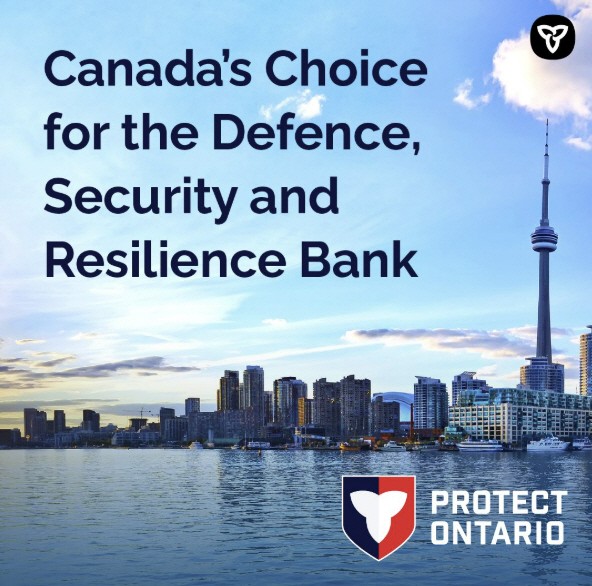 |
| This image is designed to showcase the identity of the Defense, Security, and Resilience Bank (DSRB), a multilateral financial institution, against the scenic backdrop of Ontario, Canada. It visually harmonizes the branding of the official institution with Ontario's strong commitment to hosting the DSRB headquarters. / Image generated by Gemini. Courtesy of DSRB Website |
The master key to unlocking NATO: Introducing the 'Global Defense Security Reserve Bank (DSRB)'
The formidable barrier of the traditional NATO alliance encountered during the Canadian Patrol Submarine Project (CPSP) marks a new beginning rather than an end. The Defense, Security, and Resilience Bank (DSRB)—a £100 billion multilateral financial institution spearheaded by Canada—is rapidly emerging as a powerful master key that could propel South Korea’s naval defense sector into the North American and European markets.
On the morning of July 7, Canadian Prime Minister Mark Carney announced that Germany’s ThyssenKrupp Marine Systems (TKMS) has been selected as the preferred bidder for the CPSP—a major procurement program aimed at acquiring a total of 12 next-generation submarines—and that official negotiations have commenced. Hanwha Ocean, which had drawn intense international attention, was designated as the "Reserve Supplier." In its official statement, the Canadian government noted, "Should the final contract negotiations with TKMS fall through, the negotiation rights will be transferred to ensure that exclusive talks can immediately commence with the reserve supplier, Hanwha Ocean."
While the primary opportunity was awarded to Germany, the designation represents a significant milestone, officially recognizing on the global stage that South Korea’s submarine technology and project execution capabilities satisfy the stringent, top-tier benchmarks of NATO.
"The platforms of both Germany's TKMS and South Korea's Hanwha Ocean met the rigorous and demanding criteria set by the Royal Canadian Navy, including arctic operational capabilities and long-range cruising performance," said Shim Kyu-chan, an advisor at Bae, Kim & Lee LLC and a retired rear admiral who specializes in naval defense. "The competition remained neck-and-neck right up to the final selection phase, and the conclusion was ultimately reached after what can only be described as a difficult, close decision."
Furthermore, a reliable defense security source speaking on the condition of anonymity on July 7 confirmed that South Korea is currently fielding a wave of inquiries and proposals from Eastern European nations, including Romania, as well as Middle Eastern countries, seeking to procure South Korean defense systems and establish local joint-production facilities. Amid these massive export opportunities, gaining membership in the DSRB is projected to serve as a decisive tool for expanding South Korea’s defense footprint.
Historically, one of the most significant hurdles limiting the global expansion of South Korean defense exports has been the "financial assistance bottleneck" at the single-nation level, constrained by metrics such as the statutory capital limit of the Export-Import Bank of Korea. For large-scale defense acquisitions or the construction of local joint-production facilities—which frequently range from trillions to tens of trillions of won—purchasing nations routinely demand extensive, long-term financing and credit packages alongside high-performance hardware.
This financing challenge explains why South Korean defense and security experts are focusing heavily on the DSRB, a newly established multilateral development finance institution whose headquarters have been confirmed for Montreal, Canada. Targeting a funding pool of up to £100 billion (approximately 180 to 205 trillion won), this massive financial platform leverages large-scale private capital based on the equity contributions of its member nations to provide long-term, low-interest loans and credit guarantees to allied governments and defense enterprises.
The South Korean government is currently conducting an official review of the proposal to join and contribute capital to the DSRB. Isabelle Hudon, CEO of the Business Development Bank of Canada (BDC) and Canada’s chief negotiator for the initiative, previously remarked that Canada has engaged in highly productive discussions with South Korea, placing the probability of South Korea joining at "50-50."
Should South Korea participate in the DSRB and secure a stake, its contributed capital would act as seed money, drawing in private capital from global financial markets at a multiple of tens of times the original investment. This leveraged capital could then be directly funneled into financing the acquisition of South Korean defense platforms and local joint production by nations in Eastern Europe and the Middle East, unleashing an explosive export promotion effect that transcends the limitations of domestic financial resources.
Moreover, the Canadian government's explicit stipulation that Hanwha Ocean will automatically inherit exclusive negotiation rights if talks with Germany collapse carries deep strategic weight.
If negotiations with TKMS drag out or break down due to a failure to meet the Royal Canadian Navy's punishing specifications or Canada's industrial offset requirements for local workers and firms, South Korea can immediately reclaim its spot at the main negotiating table, backed by the formidable defense financing infrastructure of the DSRB.
Even if the Canadian project ultimately concludes with a final contract for Germany, the fact that the Canadian government officially declared South Korea a "Trusted Strategic Partner" on par with Germany and Norway in formal documentation solidifies the country's standing in future global naval defense competitions.
Whether in the ongoing modernization program for the Peruvian Navy or in upcoming markets spanning Eastern Europe and the Middle East, the DSRB's multilateral financial infrastructure is expected to serve as a powerful engine, elevating the credibility of South Korean defense exports to the highest tier.
"The traditional barriers of NATO remain high, but if we capture a leading position on the DSRB platform where finance and technology converge, the globalization of South Korean defense exports will ignite at a fearsome pace far beyond Eastern Europe and the Middle East," defense analysts emphasized. "A new era of 'Team Korea' has begun, seamlessly blending technological prowess with sophisticated, multilateral financial diplomacy."
Koo Pil-hyun
Most Read
-
1
Celltrion nears additional contract with major U.S..

-
2
Putin proposes trilateral U.S.-China-Russia summit..

-
3
U.S. weighs dropping MOAB, world's most powerful n..

-
4
"Aren't those foreigners on welfare?": M..

-
5
Attention centers on APEC for possible Trump-Xi-Pu..

-
6
Saudi Arabia, Iran hold first diplomatic talks to..

-
7
China tightens grip on boosting domestic demand an..

PEOPLE







-
Address : In-Young Bldg., 34, Uisadang-daero 1-gil, Yeongdeungpo-gu, Seoul
Copyright by ASIATODAY CO., LTD. All rights resereved