



N. Korea urges flood prevention measures ahead of monsoon season
Jul 08, 2026, 09:15 am


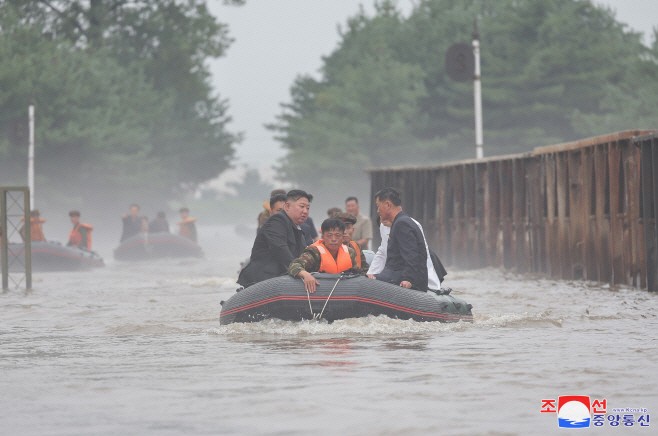 |
| North Korean Leader Kim Jong-un inspects a flooded residential area in Sinuiju, North Pyongan Province, aboard a rubber boat without wearing a life jacket, in a photo released by the Korean Central News Agency in July 2024. Only a military official in the boat is seen wearing an orange life jacket, while Kim and Premier Kim Tok-hun are without one. / Yonhap News |
North Korean authorities are ramping up their disaster preparedness campaign ahead of the summer monsoon season, warning that a complacent mindset could lead to severe consequences. Invoking lessons from continuous flood damages throughout Leader Kim Jong-un’s tenure—most notably the catastrophic flooding of the Amnok (Yalu) River in 2024—the state has issued strict orders to both cadres and residents to secure comprehensive preventive measures.
"Failing to prepare under the assumption that nothing happened last year will bring about grave repercussions," the Rodong Sinmun, the regime’s official mouthpiece, warned in a July 7 article titled "Minimize Monsoon Damage with Maximum Tension and Vigilance."
"Complacency and relaxation are the greatest enemies when it comes to preventing natural disasters," the state-run newspaper emphasized. "We must keep in mind that letting our guard down for even a single second can bring about an irreversible catastrophe, and we must take proactive, preemptive steps." The report went on to define the struggle to minimize the impact of abnormal, hazardous weather patterns as "a battle to defend the people and safeguard party policies" that leaves absolutely no room for negligence.
Pyongyang has been hammering home the importance of monsoon preparedness through its domestic media outlets since early spring.
According to Kim Kwan-ho, a research fellow at the Rural Research Institute of the Korea Rural Community Corporation, the Rodong Sinmun laid out specific directives in a May article titled "Flawless Preparations to Cope with Hazardous Weather." The publication ordered enhancements to water storage, conveyance, and discharge capacities, alongside upgrading drainage facilities. It also called for re-leveling farmland drainage ditches and embankments, testing drainage and pumping machinery, clearing waterways to boost flow capacity, and establishing landslide prevention protocols.
The push intensified in June with another editorial outlining ongoing regional engineering projects. These included dredging operations along the Chongchon River in North Pyongan Province, riverbed clearing in flood-prone zones of Suan County, North Hwanghae Province, reinforcing coastal embankments in Jangyon County, South Hwanghae Province, and establishing comprehensive drainage plans by the North Hamgyong Province Rural Economy Committee. Follow-up reports on July 3 and 6 continued to stoke vigilance by raising alarms over potential monsoon flooding.
The heightened alert stems from the trauma of July 2024, when torrential rains triggered a massive overflow of the Amnok River, submerging over 4,100 homes in Sinuiju City and Uiju County within North Pyongan Province. In response to the disaster, the regime demonstrated its policy commitment to breaking the cycle of recurring damage by creating a dedicated Ministry of Disaster Prevention the following year. Furthermore, Pyongyang has been working to build an integrated water management database, upgrade its flood prevention and recovery systems, and improve weather forecasting accuracy through a technical partnership with Russia’s Federal Service for Hydrometeorology and Environmental Monitoring.
Experts note, however, that these mitigation efforts face steep hurdles due to severe financial constraints. "North Korea relies heavily on strict top-down party control, the mass mobilization of military and civilian labor, and land management activities designed to mitigate agricultural and forestry damage," Kim Kwan-ho analyzed. "To truly prevent natural disasters, the country requires substantial investments in disaster-prevention infrastructure, scientific forecasting models, and highly sophisticated rapid warning systems."
Kim suggested that weather and hydrological monitoring could serve as a viable entry point for inter-Korean engagement. "There is a strong possibility for cooperation in meteorology and hydrology through multilateral frameworks aligned with international norms," Kim added. "Rather than framing it strictly as a bilateral issue, it would be more effective to persuade Pyongyang under the banner of a joint response to extreme weather patterns affecting the entire Korean Peninsula."
Mok Yong-jae
Most Read
-
1
Celltrion nears additional contract with major U.S..

-
2
Putin proposes trilateral U.S.-China-Russia summit..

-
3
U.S. weighs dropping MOAB, world's most powerful n..

-
4
"Aren't those foreigners on welfare?": M..

-
5
Attention centers on APEC for possible Trump-Xi-Pu..

-
6
Saudi Arabia, Iran hold first diplomatic talks to..

-
7
China tightens grip on boosting domestic demand an..

PEOPLE







-
Address : In-Young Bldg., 34, Uisadang-daero 1-gil, Yeongdeungpo-gu, Seoul
Copyright by ASIATODAY CO., LTD. All rights resereved