



Ruling, opposition parties clash over Information and Communications Network Act
Jul 06, 2026, 09:19 am


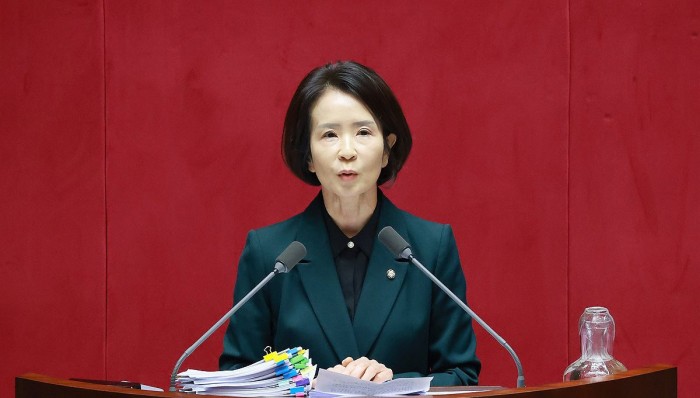 |
| Choi Soo-jin, chief spokesperson of the People Power Party. / Courtesy of Yonhap |
The Democratic Party of Korea and the People Power Party clashed head-on on July 5 over an amendment to the Information and Communications Network Act scheduled to take effect on July 7.
The People Power Party labeled the amendment a "gag law," raising concerns over potential infringements on the freedom of expression, while the Democratic Party shot back, branding it an "anti-fake news and cyber wrecker law."
Choi Soo-jin, chief spokesperson of the People Power Party, stated in a commentary that day, "The criteria for determining what constitutes 'false or manipulated information' are exceedingly vague. Under this standard, even posts criticizing the government or raising reasonable suspicions could become subjects of dispute."
Spokesperson Choi went on to criticize the bill, saying, "To avoid the burden of massive damages and administrative fines, platforms will have no choice but to preemptively delete posts whose illegality has not been clearly determined. This will structurally lead to over-deletion and virtual prior censorship."
People Power Party Representative Joo Jin-woo announced his intention to file a constitutional lawsuit against the implementation of the amendment. Joo claimed on social media, "The law is a rushed piece of legislation that goes into effect without even establishing an agency to judge what constitutes false or manipulated information. It clearly violates constitutional provisions, including the prohibition of prior censorship, the principle of proportionality, and the freedom of speech and expression." He added, "Once the law takes effect, I will contest the unconstitutionality of social media censorship as a private citizen."
The Democratic Party countered, arguing that the intent of the law was being distorted. Spokesperson Jeon Su-mi stated during a briefing, "This law is not a 'gag law' to silence ordinary citizens, but rather an 'anti-fake news and cyber wrecker law' aimed at stopping those who commit character assassination and destroy a healthy public square."
Spokesperson Jeon further emphasized, "Not a single citizen sharing their daily life, expressing legitimate political opinions, or fiercely criticizing authority will face punishment under this law." Turning her criticism toward the People Power Party, she asked, "Since when did you become the self-proclaimed guardians of false, manipulated information and cyber wreckers? Unable to forget the past where you benefited from malicious fake news, you are now mislabeling minimal social filtering as censorship."
Regarding alternative bills proposed by the People Power Party, Spokesperson Jeon pointed out, "Suggesting we filter out false and manipulated information and only regulate illegal information is tantamount to declaring a dereliction of duty, as it means turning a blind eye to cleverly manipulated fake news."
Meanwhile, the revised Information and Communications Network Act chiefly allows victims to claim punitive damages of up to five times the actual losses if false or manipulated information is distributed to inflict harm on others. Platforms or individuals could also face administrative fines of up to 1 billion won for repeated distribution.
The amendment was passed through the National Assembly last December, led by the Democratic Party.
Shim Jun-bo
Most Read
-
1
Trump shares map on social media labeling Strait o..

-
2
Kia Sportage outperforms Mazda CX-5 in German auto..

-
3
Houthis launch successive attacks on Saudi airport..

-
4
U.S. deploys carrier, 10,000 more troops to Middle..

-
5
Trump rejects Iran's offer to open Strait of Hormu..

-
6
N. Korea conducts first swarm attack drill with dr..

-
7
U.S.-China summit falls short on substance as Trum..

PEOPLE






HEADLINE NEWS
- Seoul dismisses Ukraine's claim of 'S. Korean support for Russia' as "inaccurate and inappropriate"
- S. Korea, Japan race to develop nuclear-powered submarines
- Henri Kagan, Kenso Soai win Nobel Prize in Chemistry for uncovering how mol..
- Vance says Alaska LNG cooperation will move forward with Seoul's current or..

-
Address : In-Young Bldg., 34, Uisadang-daero 1-gil, Yeongdeungpo-gu, Seoul
Copyright by ASIATODAY CO., LTD. All rights resereved