



U.S. shipbuilding bill draws attention as watershed for Korea-U.S. cooperation
Jul 03, 2026, 10:05 am


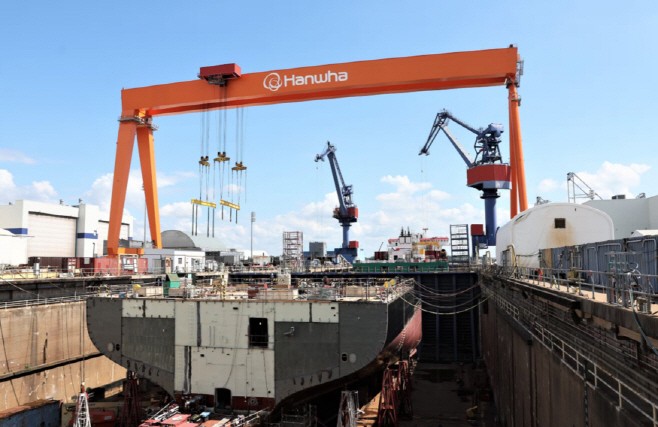 |
| An overview of Hanwha Philly Shipyard in Philadelphia, US. / Courtesy of Hanwha |
Korea-US shipbuilding cooperation stands at a critical crossroads as the US Congress pushes for a National Defense Authorization Act (NDAA) that restricts the procurement of naval vessels and core components built in foreign shipyards.
Concerns are growing that the finalization of this bill could limit the joint naval construction plans that the South Korean shipbuilding industry has anticipated. Conversely, the Senate has passed a version that allows certain auxiliary ships to be built in allied nations' yards, making the final legislative outcome the single largest variable determining the direction of bilateral maritime cooperation.
According to shipbuilding industry sources on July 2, the US House Armed Services Committee incorporated an amendment proposed by Representative Jared Golden into the Fiscal Year 2027 NDAA last month on June 5. The amendment restricts the use of US Navy funds to procure combatant vessels or major components constructed at foreign shipyards.
While the US Navy has never directly imported a combatant ship from abroad, and current laws already prohibit foreign procurement of core components like hulls and superstructures in principle, this amendment aims to close remaining loopholes and reinforce the mandate that US warships must be built within the United States.
However, analysts point out that this protectionist shift conflicts with the US government's broader strategy to counter China's overwhelming maritime dominance. While the US has steadily lost its global shipbuilding edge, China has locked in absolute production capacity.
According to the Center for Strategic and International Studies (CSIS), the US accounts for a mere 0.1% of global shipbuilding output, compared to China's 53.3%. Compounding this gap, 82% of new warships ordered by the US Navy are facing construction delays, leading experts to estimate that China’s shipbuilding capacity is now more than 200 times that of the United States.
In response to this deficit, Washington has recently pivoted toward expanding shipbuilding cooperation with allies, including South Korea. To narrow the gap with China, the US has pursued the Maritime Action Plan (MAP) while exploring a bridge strategy linked to foreign shipbuilders investing directly in US facilities.
Aligned with this shift, South Korean shipbuilders have been accelerating their push into the US market.
Hanwha Ocean expanded its footprint by acquiring the Philly Shipyard in Philadelphia and announcing large-scale facility investments. HD Hyundai signed a Memorandum of Agreement (MOA) with Huntington Ingalls, the largest military shipbuilder in the US, to jointly construct naval support vessels and collaborate on artificial intelligence (AI) and automation technologies. Samsung Heavy Industries and DSEC are also working with General Dynamics on design cooperation for next-generation logistics support ships.
Expectations for deepened ties climbed even higher following a recent phone call between US President Donald Trump and South Korean President Lee Jae-myung, where Trump explicitly highlighted South Korea's robust naval shipbuilding capabilities.
Against this backdrop, experts warn that if the House amendment stands unchanged, it will clash directly with the strategic goal of leveraging allied capabilities. While Washington tries to protect its domestic industrial base and expand its naval fleet simultaneously, internal congressional divisions have surfaced regarding how far to permit the use of foreign shipyards.
In fact, the Senate Armed Services Committee voted on June 11 to pass a bill that allows up to two oilers and two transport ships to be constructed in foreign shipyards. While the House seeks a blanket restriction on foreign construction, the Senate explicitly acknowledges the necessity of utilizing allied shipyards for select auxiliary vessels.
Industry insiders expect the outcome of the House-Senate reconciliation process to heavily reshape the US strategies of South Korean shipbuilders. The scope of naval cooperation and localized investment plans pursued by Hanwha Ocean and HD Hyundai Heavy Industries will likely pivot based on the final statutory language.
In contrast, the impact on the Maintenance, Repair, and Overhaul (MRO) sector is projected to remain limited. HD Hyundai Heavy Industries maintained that because the amendment targets foreign hull construction, it does not alter the legal framework governing the MRO business currently underway.
Hanwha Ocean also anticipates minimal short-term disruptions, given its secured foothold at the Philly Shipyard. However, if US policy tightens requirements for domestic production shares, the financial burden of investing in local facilities and securing skilled labor could rise. Ultimately, localized US production capacity is poised to emerge as the core competitive metric in future bilateral cooperation.
"The crux of this legislation lies not in MRO, but in defining the exact boundaries of how far the US can go in co-building warships with its allies," an industry official stated. "Depending on the final text of the bill, the investment blueprints of Korean firms and the overarching trajectory of Korea-US shipbuilding cooperation will experience a significant shift."
Han Dae-ui
Most Read
-
1
U.S. Treasury Secretary Bessent publicly warns ove..

-
2
Celltrion’s Omlyclo gains ground in major European..

-
3
U.S. strikes Iran after a month, hits IRGC rocket..

-
4
Hyundai Motor Group breaks ground on integrated st..

-
5
Russia faces warning signs over prolonged war econ..

-
6
Anti-Western solidarity strengthens amid Trump's e..

-
7
U.S. strikes 3 Iranian oil tankers, Iran vows reta..

PEOPLE






HEADLINE NEWS

-
Address : In-Young Bldg., 34, Uisadang-daero 1-gil, Yeongdeungpo-gu, Seoul
Copyright by ASIATODAY CO., LTD. All rights resereved