



Male securities professionals' parental leave rates plummet
Jul 03, 2026, 09:47 am


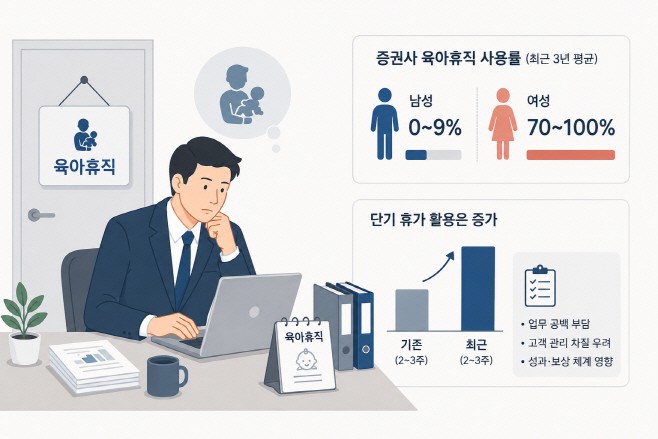 |
| This image was generated by AI. |
While domestic securities firms posted record-high performances amid last year's stock market boom, taking parental leave remains a difficult choice for male employees. Over the past three years, the male parental leave utilization rate at major securities firms mostly stayed at 0% or in the single digits, presenting a stark contrast to female utilization rates, which generally exceeded 70%. Although the government is continuously introducing policies to encourage male participation in childcare—such as expanding paternity leave—industry insiders point to client-based sales structures and performance-centric compensation systems as hurdles blocking the spread of long-term parental leave.
According to the Financial Supervisory Service's electronic disclosure system on July 2, an analysis of business reports from ten major domestic securities firms revealed that the male parental leave utilization rate stood at 0% last year at four firms: KB Securities, NH Investment & Securities, Korea Investment & Securities, and Kiwoom Securities. Daishin Securities (8%), Shinhan Securities (7.08%), Mirae Asset Securities (6%), Hana Securities (5.3%), Meritz Securities (2.9%), and Samsung Securities (2.17%) all remained in the single digits as well. In short, the male parental leave rate fell below 10% at eight out of the ten major firms.
Trends over the past three years followed a similar trajectory. Korea Investment & Securities recorded a 0% male parental leave utilization rate for three consecutive years from 2023 through last year. KB Securities dropped from 6% in 2023 to 0% in both 2024 and last year, while Kiwoom Securities registered 5.13% and 5.41% before hitting 0% last year. Mirae Asset Securities fell from 11% to 6%, and Meritz Securities edged down from 4.3% to 2.9%, illustrating that male parental leave has generally stalled.
Conversely, female parental leave appears to have largely taken root. Last year, Kiwoom Securities recorded a 100% utilization rate, while Samsung Securities and Daishin Securities posted 95% each. NH Investment & Securities stood at 81.8%, Korea Investment & Securities at 77.1%, and KB Securities and Mirae Asset Securities at 75% each. Except for Meritz Securities (40%), most securities firms demonstrated high utilization rates above 70%.
Unlike long-term parental leave, short-term paternity leave is rapidly gaining traction. The number of paternity leave users at KB Securities rose from 33 in 2024 to 50 last year, while Meritz Securities saw an increase from 15 to 38, and Daishin Securities went from 21 to 28. The industry explains that while short-term leave of around two to three weeks is increasingly utilized, long-term parental leave spanning roughly a year remains stagnant due to heavy burdens regarding career gaps.
At the core of this backdrop lies the unique sales structure of the securities industry. In fields like Private Banking (PB) and Investment Banking (IB), relationships with assigned clients or transactional outcomes directly dictate individual performance and compensation. Taking an extended leave creates significant pressure, as individual clients or ongoing deals may be reassigned to other colleagues, forcing employees to rebuild their client base upon return.
Industry observers note that this pressure mounted even further during periods like last year, when transaction volumes surged and securities firms racked up historic earnings. The greater the market opportunities, the higher the opportunity cost of stepping away from work for an extended period.
"It is not an environment where the company actively blocks parental leave, but front-office sales professionals inevitably face setbacks in terms of performance bonuses and incentives if they take prolonged leave," a source from the industry stated. "Since a robust stock market brings more opportunities to generate returns, there are instances where employees shorten their leave or return to the office sooner than expected."
Park Ju-yeon
Most Read
-
1
U.S. Treasury Secretary Bessent publicly warns ove..

-
2
Celltrion’s Omlyclo gains ground in major European..

-
3
U.S. strikes Iran after a month, hits IRGC rocket..

-
4
Hyundai Motor Group breaks ground on integrated st..

-
5
Russia faces warning signs over prolonged war econ..

-
6
Anti-Western solidarity strengthens amid Trump's e..

-
7
U.S. strikes 3 Iranian oil tankers, Iran vows reta..

PEOPLE





HEADLINE NEWS

-
Address : In-Young Bldg., 34, Uisadang-daero 1-gil, Yeongdeungpo-gu, Seoul
Copyright by ASIATODAY CO., LTD. All rights resereved