



Government to supply emergency aid to SMEs hit by high exchange rate
Jul 03, 2026, 09:37 am


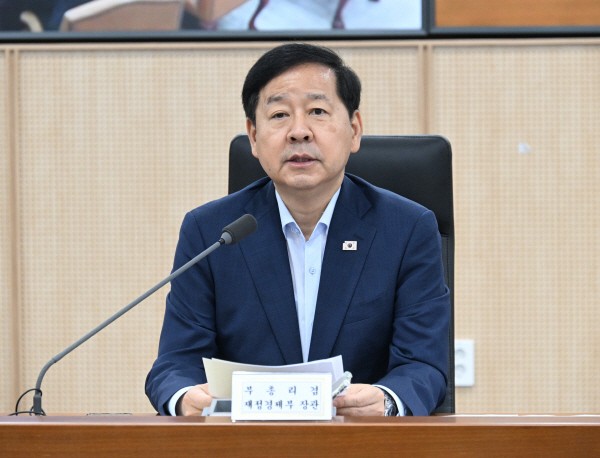 |
| Deputy Prime Minister and Minister of Finance and Economy Koo Yun-cheol delivers opening remarks at the Emergency Economic Headquarters Meeting and Meeting of Ministers Related to the Economy held at the Government Complex Sejong on July 3. / Courtesy of the Ministry of Finance and Economy |
The government will supply 14.9 trillion won in emergency management funds and expand tax and trade insurance support to assist small and medium-sized enterprises (SMEs) struggling with financial difficulties and the rising cost of importing raw materials due to a prolonged high-exchange-rate environment.
During the Emergency Economic Headquarters Meeting and Meeting of Ministers Related to the Economy held on July 3, chaired by Deputy Prime Minister and Minister of Finance and Economy Koo Yun-cheol, the government announced the "Emergency Support Plan for SMEs Facing Management Difficulties Due to High Exchange Rates." This package focuses on providing liquidity to SMEs facing growing operational burdens from sustained high exchange rates and boosting their capacity to respond to exchange rate volatility.
First, the government will provide a total of 14.9 trillion won in emergency management funds. Out of the 23.7 trillion won in policy financing originally set aside to respond to the Middle East crisis, the remaining 13.8 trillion won will be repurposed to support companies affected by the high exchange rate, with an additional 1.1 trillion won in new funds to be injected. The scale of this support will be further expanded depending on how quickly the policy funds are depleted.
Specifically, a dedicated track for companies affected by the high exchange rate will be established under the Emergency Management Stabilization Fund managed by the SMEs and Startups Agency. In particular, for SMEs whose raw and subsidiary material imports account for 20% or more of their revenue, the support criteria will be significantly relaxed, allowing them to receive aid without having to meet the previous requirement of a 10% or greater decline in revenue or operating profit.
Additionally, the Export-Import Bank of Korea will expand its special crisis response program from 7 trillion won to 8 trillion won, widening its maximum interest rate discount from 2.0 percentage points (p) to 2.2%p. Along with this, a new "Win-Win Low-Interest Loan to Overcome High Exchange Rates" will be introduced, supplying funds at interest rates near procurement costs. The Korea Technology Finance Corporation will raise its guarantee ratio for emergency management stabilization guarantees from 95% to 100% and expand its guarantee fee reduction from 0.3%p to 0.4%p.
The government also decided to strengthen trade insurance and exchange rate fluctuation insurance support. Requirements will be eased so that small, medium, and mid-sized enterprises with no prior export track record can still sign up for import insurance, and import insurance premiums will be discounted by 50% until April next year. For companies facing increased import costs for core raw materials, the Korea Trade Insurance Corporation will offer preferential treatment by doubling their import financing loan guarantee limits.
The supply of exchange rate fluctuation insurance will be expanded from 1.2 trillion won to 1.3 trillion won, and the insurance premium discount for SMEs will be increased from 15% to 30%. The eligibility for subscription will also be broadened from select raw material importers to importers of all goods, excluding luxury items.
A dedicated support track for companies affected by the high exchange rate will be created within the export voucher program with 10 billion won in funding, and the trade insurance premium support limit will be temporarily doubled from 10 million won to 20 million won. Efforts will also be made to improve the system so that trade insurance premiums can be prepaid instead of being settled after the contract ends. SMEs utilizing loans from the Export-Import Bank of Korea will be provided with a free currency conversion option, allowing them to switch their loan currency between foreign currencies and the Korean won, or between different foreign currencies.
Tax support will be provided in tandem. For SMEs experiencing management difficulties due to the high exchange rate, deadlines for paying corporate tax, value-added tax, income tax, and customs duties will be extended. Consulting services will also be provided to help companies reflect exchange rates in the delivery price indexation system. Companies that demonstrate excellence in operating the indexation system will receive incentives, such as exemptions from ex-officio investigations into consignment and entrustment transactions. Furthermore, the performance of financial institutions in supporting companies affected by the high exchange rate will be reflected in their win-win finance index evaluations. The government plans to centrally manage corporate difficulties through export support centers and provide a one-stop guide for related support policies.
Lee Ji-hoon
Most Read
-
1
U.S. Treasury Secretary Bessent publicly warns ove..

-
2
Celltrion’s Omlyclo gains ground in major European..

-
3
U.S. strikes Iran after a month, hits IRGC rocket..

-
4
Hyundai Motor Group breaks ground on integrated st..

-
5
Russia faces warning signs over prolonged war econ..

-
6
Anti-Western solidarity strengthens amid Trump's e..

-
7
U.S. strikes 3 Iranian oil tankers, Iran vows reta..

PEOPLE






HEADLINE NEWS

-
Address : In-Young Bldg., 34, Uisadang-daero 1-gil, Yeongdeungpo-gu, Seoul
Copyright by ASIATODAY CO., LTD. All rights resereved