



Will minimum wage be left to public interest members again this year?
Jul 03, 2026, 09:27 am


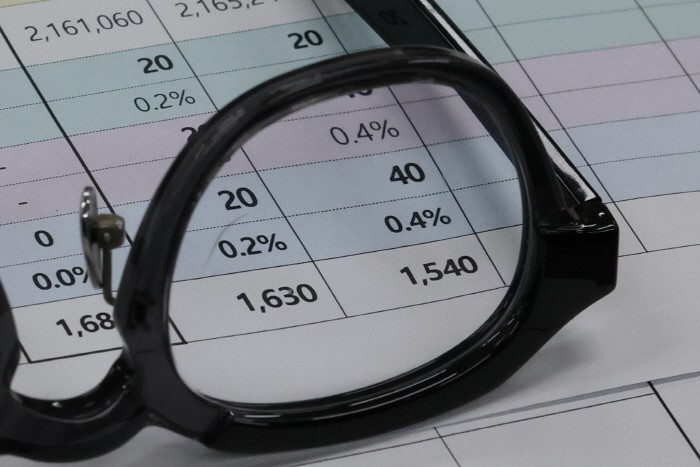 |
| At the 11th plenary session held at the Minimum Wage Commission in the Government Complex Sejong on July 2, documents recording the revised proposals submitted by the employee and employer members respectively sit on the seat of Chairman Kwon Soon-won. / Yonhap News |
Labor and management presented their third revised proposals for next year's minimum wage but failed to significantly narrow their differences. Despite additional concessions from both sides, the gap remains at 1,410 won, increasing the likelihood that this year's minimum wage determination will rely on mediation or a vote by public interest members rather than a mutual agreement between labor and management.
The Minimum Wage Commission held its 11th plenary session at the Government Complex Sejong on July 2 to deliberate on the minimum wage rate applicable for 2027. On this day, the employee members proposed 11,800 won per hour as their third revised offer, while the employer members suggested 10,390 won. Compared to this year's minimum wage of 10,320 won, this represents a 14.4% increase from labor and a 0.7% increase from management.
Previously, in the second revision, labor had proposed 11,900 won and management 10,360 won. The 1,540 won gap during the second revision narrowed by 130 won to 1,410 won in the third revision. Labor lowered its previous offer by 100 won, while management raised theirs by 30 won.
Labor and management clashed over the criteria for determining the minimum wage. Ryu Ki-seop, Secretary General of the Federation of Korean Trade Unions (FKTU), stated, "Relying excessively on a specific indicator like 60% of the median wage, rather than the actual cost of living for workers, is a fundamental issue." Lee Mi-seon, Vice Chair of the Korean Confederation of Trade Unions (KCTU), argued, "The starting point of the discussion should begin with the inflation rate. We must take our first step at a level exceeding the 2.7% inflation rate announced by the Bank of Korea."
Management put forward the payment capability of small business owners and small and medium-sized enterprises (SMEs). Ryu Ki-jung, Executive Director of the Korea Enterprises Federation (KEF), noted, "The economic situation should not be masked by the illusion of a semiconductor boom," citing indices for business closures, debt, and delinquency to highlight that difficulties on the ground are deepening. Yang Ok-seok, head of the Human Resources Policy Bureau at the Korea Federation of Small and Medium Business (KBIZ), said, "Labor costs have downward rigidity, meaning they do not decrease once they go up, so the cumulative impact of the minimum wage is significant."
While both sides speak of 'objective indicators,' there is no common ground on which indicator to prioritize. With labor emphasizing the actual cost of living and inflation, and management underscoring payment capability and employment impact, this year's minimum wage deliberations are repeating the pattern of debates over criteria and tug-of-wars over revised proposals.
Since the introduction of the system, the minimum wage has mostly been determined by votes rather than consensus. Although the minimum wage applicable for 2026 was decided through a labor-management-public consensus for the first time in 17 years since 2008, cases of mutual agreement have occurred only eight times since the system's inception. Analysts interpret last year's consensus as an exceptional case under a unique political climate following the launch of a new administration, where both labor and management felt pressured by a voting showdown.
For this reason, critics continue to point out that the structure for determining the minimum wage itself needs reform. The current commission consists of 27 members, with 9 members each from employees, employers, and the public interest. However, when labor and management fail to find common ground, the process has repeatedly defaulted to putting a mediation proposal by public interest members to a vote. Even if the statutory deliberation deadline is missed, there is no issue with applying the wage for the following year as long as the Minister of Employment and Labor officially notices the minimum wage by August 5 every year, solidifying the practice of deliberations dragging into July.
Park Ji-soon, a professor at Korea University School of Law, commented, "The current commission operates closer to a method of relying on a final vote to reach a conclusion rather than finding common ground through sufficient discussion between labor and management." He added, "Since the minimum wage functions as a standard for the overall labor market, a deliberation system based on objective data and expert review is necessary."
Kim Nam-hyeong
Most Read
-
1
Celltrion’s Omlyclo gains ground in major European..

-
2
Trump demands rates fall below 1% as Fed hikes for..

-
3
Hyundai Motor Group breaks ground on integrated st..

-
4
U.S. strikes 3 Iranian oil tankers, Iran vows reta..

-
5
Trump makes $1 trillion bet ahead of midterm elect..

-
6
Iran resumes ballistic missile production, assembl..

-
7
Samsung Electronics, Mistral AI to jointly develop..

PEOPLE





-
Address : In-Young Bldg., 34, Uisadang-daero 1-gil, Yeongdeungpo-gu, Seoul
Copyright by ASIATODAY CO., LTD. All rights resereved