



S. Korea remains tied to rigid 6-month detention limit as reform talks stall
Jul 02, 2026, 09:18 am


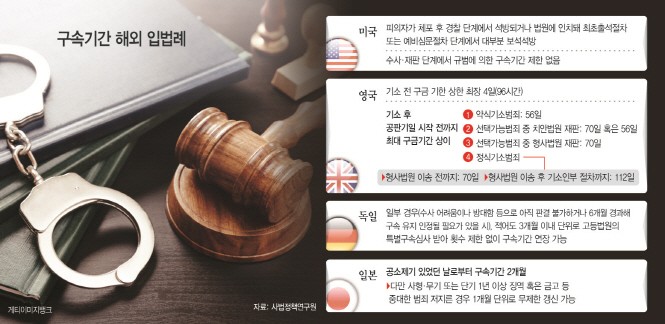 |
In contrast to South Korea, which strictly limits first-instance trial detention to six months, major foreign nations either impose no such caps or operate their systems flexibly based on the nature of the case and the necessity of detention. Critics argue that for white-collar crimes that inevitably require long-term hearings, the six-month detention limit exposes clear regulatory bottlenecks, underscoring the urgent need for legislative revision.
Under the South Korean Criminal Procedure Act, the initial detention period during a first-instance trial is set at two months, with a maximum of two extensions allowed for two months each. Consequently, a defendant can be detained for a maximum of six months during the first-instance phase.
However, complex white-collar cases—such as financial and securities fraud or large-scale breach of trust and embezzlement—are notoriously difficult to wrap up within six months. The sheer volume of case records and intricate legal battle lines mean these trials require significantly longer periods than standard criminal cases.
In fact, some white-collar defendants exploit these structural loopholes to intentionally delay proceedings by replacing their legal teams or requesting massive blocks of witnesses. They then secure release on bail right as their six-month detention cap expires. To counter this tactic, prosecutors have resorted to "split indictments"—filing separate, additional arrest warrants using criminal charges that were omitted from the court’s initial warrant.
In May, this newspaper partnered with the office of National Assembly Legislation and Judiciary Committee Chair Seo Young-kyo (Democratic Party of Korea, Seoul Jungnang-gap) to conduct an exhaustive analysis of granted bail petitions (excluding those initiated by court discretion) across the Seoul Central District Court and the Eastern, Southern, Northern, and Western district courts in 2024. The results revealed that more than half of all successful bail petitions involved white-collar offenses, including fraud and violations of the Capital Markets Act or the Act on the Aggravated Punishment of Specific Economic Crimes.
This data has fueled growing demands to overhaul the current statutory limits on trial detention. Indeed, a cross-border comparison reveals that almost no other major jurisdiction maintains such a rigid, uniform cap. Most countries either leave detention duration open-ended or adjust it dynamically based on the gravity of the charges and the specific necessity for continued custody.
According to a 2023 report titled "A Study on Judicial Detention Periods" published by the Judicial Policy Research Institute, the United States places no statutory caps on detention during the investigation or trial phases. The United Kingdom limits pre-charge detention to a maximum of four days, while setting distinct pre-trial custody time limits ranging from 56 to 112 days depending on the category of the offense.
Germany, a civil law jurisdiction that heavily influenced South Korea’s legal framework, imposes no blanket statutory cap on general trial detention, restricting it to one year only when detention is grounded strictly on the "risk of reoffending." Furthermore, to detain a suspect beyond six months prior to the commencement of the main trial, the case must undergo special review by a higher regional court every three months. Japan establishes an initial post-indictment detention period of two months but permits rolling one-month extensions for serious crimes.
The judiciary has acknowledged these systemic bottlenecks. When asked by this newspaper to evaluate the current statutory caps, the National Court Administration of the Supreme Court stated, "As trials increasingly center on courtroom hearings and oral arguments, and as criminal cases grow more complex, the current detention limits can act as a constraint on thorough and exhaustive judicial review in certain cases."
In June last year, amid concerns that defendants tied to the December 3 martial law incident facing sedition charges might walk free due to expiring detention limits, the National Assembly introduced an amendment to the Criminal Procedure Act aimed at extending trial detention periods. However, the proposed bills remain stalled in the Legislation and Judiciary Committee.
Son Seung-hyun
Most Read
-
1
Celltrion nears additional contract with major U.S..

-
2
Putin proposes trilateral U.S.-China-Russia summit..

-
3
U.S. weighs dropping MOAB, world's most powerful n..

-
4
"Aren't those foreigners on welfare?": M..

-
5
Attention centers on APEC for possible Trump-Xi-Pu..

-
6
Saudi Arabia, Iran hold first diplomatic talks to..

-
7
China tightens grip on boosting domestic demand an..

PEOPLE






-
Address : In-Young Bldg., 34, Uisadang-daero 1-gil, Yeongdeungpo-gu, Seoul
Copyright by ASIATODAY CO., LTD. All rights resereved