



MCEE to supply 650,000 tons of water daily to southwest semiconductor fabs—but how?
Jul 01, 2026, 09:15 am


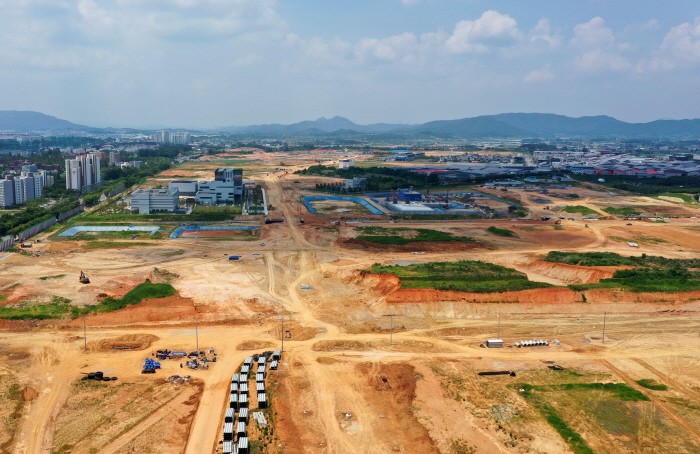 |
| The Gwangju High-Tech District 3, which is being considered as one of the candidate sites for new semiconductor fabrication plants, following investment announcements by Samsung Electronics and SK Hynix at the Southwest Advanced Industry Development Vision Briefing on the 30th. / Courtesy of Yonhap News Agency |
The government will utilize the Dongbok, Juam, and Jangseong dams and convert power-generation and agricultural water into industrial water to secure a stable water supply for the new semiconductor industrial complex in the southwest region. However, critics point out that the blueprint is merely a collection of previously proposed drought mitigation measures.
According to the Ministry of Climate, Energy, and Environment on the 30th, the detailed plan to supply 650,000 tons of water daily to the new semiconductor cluster includes raising the height of the Dongbok Dam to secure 300,000 tons and tapping into 150,000 tons of unused surplus from the Juam and Jangseong dams.
The ministry also plans to divert water used for power generation and agriculture to industrial purposes. This involves redirecting 100,000 tons of power-generation water from the Boseonggang Dam and replacing agricultural water from the Naju Dam with Yeongsan River water, thereby freeing up another 100,000 tons of dam supply. In addition, an alternative measure is being prepared to process 300,000 tons of reclaimed water from the Gwangju 1st Wastewater Treatment Plant through reverse osmosis (RO) systems to use as standard industrial process water.
However, critics argue that the proposed 650,000-ton daily supply plan relies on assembling older ideas reviewed during past extreme droughts in the Honam region, rather than developing new water resources. They raise concerns that while precipitation volatility in the southern regions has intensified due to climate change, converting these sources into a constant, daily industrial supply for high-tech semiconductor fabs could leave the region with zero buffer capacity during severe droughts. Securing additional water for the residential support complexes needed to house the influx of workforce remains another looming challenge.
Analysts note that it will be difficult to handle the demand without expanding the overall capacity of the Yeongsan and Seomjin river basins, whether through dam expansions or the construction of new reservoirs.
"As greenhouse farming expands, agriculture is shifting toward groundwater extraction, yet the dams continue to release the same amount of surface water," a ministry official stated, adding that the exact volume of current groundwater utilization remains unquantified. "We need to devise a more rational utilization framework."
A core issue is how to restructure water rights while considering food security, given that South Jeolla Province serves as the nation's largest agricultural production hub. Actual negotiations are stacked with sensitive issues, such as cases where farming has effectively ceased but the entity still holds water permits, or instances where the location of water consumption differs from the water source.
"We are currently in the stage of finalizing details to match the specific demands of the corporations," another ministry official explained. "This is an opportunity to remodel and scale up our infrastructure, keeping historical droughts in mind, to fix the water imbalances across different basins that went unresolved in the past."
Lee Jeong-yeon
Most Read
-
1
Celltrion’s Omlyclo gains ground in major European..

-
2
Trump demands rates fall below 1% as Fed hikes for..

-
3
Hyundai Motor Group breaks ground on integrated st..

-
4
U.S. strikes 3 Iranian oil tankers, Iran vows reta..

-
5
Trump makes $1 trillion bet ahead of midterm elect..

-
6
Iran resumes ballistic missile production, assembl..

-
7
Samsung Electronics, Mistral AI to jointly develop..

PEOPLE





-
Address : In-Young Bldg., 34, Uisadang-daero 1-gil, Yeongdeungpo-gu, Seoul
Copyright by ASIATODAY CO., LTD. All rights resereved