



Ministry backs power equipment exports amid AI boom
May 29, 2026, 04:42 pm


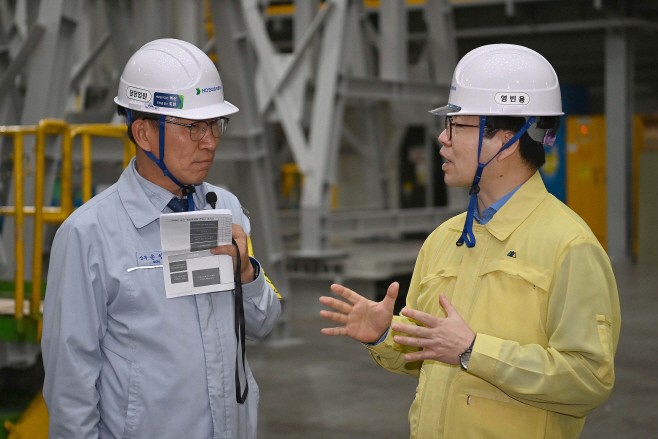 |
| Yeo Han-koo, Minister for Trade at the Ministry of Trade, Industry and Energy, tours the primary transformer assembly and production lines during a site visit to HD Hyundai Electric’s manufacturing facility located in Dong-gu, Ulsan, on May 29. / Photo via Ministry of Trade, Industry and Energy |
The South Korean government has rolled out an aggressive support framework aimed at boosting the global competitiveness of the domestic power equipment industry, which has been capturing unprecedented export milestones. Backed by expanding artificial intelligence (AI) data center infrastructure investments and a sweeping replacement cycle for aging power grids in the United States, Korean electrical equipment manufacturers have secured highly robust export pipelines. In response to this shifting macro dynamic, the Ministry of Trade, Industry and Energy announced targeted interventions to expand trade financing and facilitate global procurement project discoveries.
The Ministry stated on May 29 that Yeo Han-koo, Minister for Trade, conducted an on-site inspection of HD Hyundai Electric’s core transformer production lines in Ulsan and hosted an executive roundtable with leading representatives from the electrical equipment industry.
During his operational review, Minister Yeo assessed the optimization of production facilities responding to escalating global infrastructure demands and examined the end-to-end assembly process for high-voltage systems. Following the inspection, he met with corporate leadership teams to address cross-border logistical expansion strategies and mitigate on-the-ground operational bottlenecks.
"Despite sustained geopolitical instability, our electrical equipment industry continues to dominate the global marketplace through undisputed technological superiority," Minister Yeo emphasized. "To ensure that our enterprise network retains its structural leadership across international markets, the government will deploy enhanced trade financing programs and expand our operational footprint by leveraging commercial trade channels with key bilateral partners."
South Korea's aggregate export volumes maintain a resilient upward trajectory despite prevailing external uncertainties, including regional conflicts in the Middle East and evolving tariff frameworks in the United States. National export values historically breached the $700 billion threshold to reach $709.3 billion last year, maintaining robust structural momentum this year with consecutive monthly volumes exceeding $80 billion through March and April.
Within this broader performance, the power equipment segment has maintained a continuous growth curve, powered by a convergence of global hyperscale AI buildouts, transitioning renewable energy infrastructures, and systemic grid modernization programs across major economies. Total electrical equipment exports expanded from $12 billion in 2021 to $16.7 billion in 2025, with current trajectories pacing toward another record-breaking annual performance. Cumulative exports recorded between January and April reached $5.6 billion, marking a 3.8% increase compared to the corresponding period last year.
Market analytics indicate that surging global demand for institutional hardware—including transformers, circuit breakers, power cables, and electric motors—remains the primary engine driving this export boom. Notably, the multi-year modernization of historical power grids in the United States, alongside the rapid scaling of high-density AI data centers, has emerged as a transformative long-term growth catalyst for domestic manufacturers.
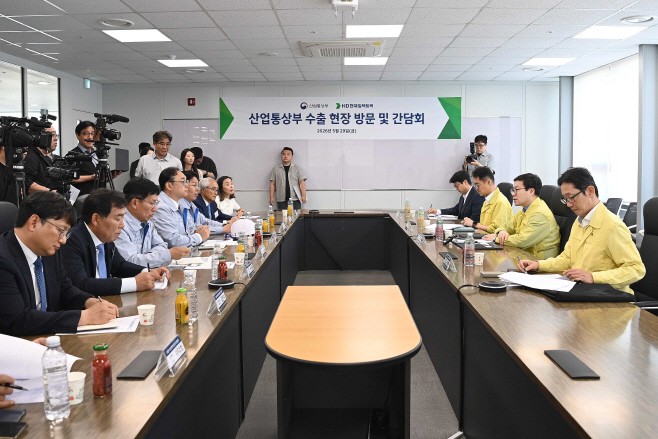 |
| Yeo Han-koo, Minister for Trade at the Ministry of Trade, Industry and Energy, conducted a site visit to HD Hyundai Electric’s manufacturing facility in Dong-gu, Ulsan, on May 29. During the visit, Minister Yeo hosted a strategic policy round table with executive leadership and representatives from prominent electrical equipment exporters—including HD Hyundai, Samdong, and Inheung Industrial—to deliberate on comprehensive government intervention programs aimed at expanding global market channels for "K-power equipment." / Photo via Ministry of Trade, Industry and Energy |
During the roundtable discussion, Minister Yeo also noted that the expanding global demand for information technology (IT) infrastructure, including high-density AI data centers, has served as a primary catalyst boosting power equipment exports. "The surging infrastructure demand driven by the IT sector and next-generation artificial intelligence data centers is contributing a massive portion to our export volumes," Yeo stated. "To sustain this robust export momentum, the ministry will actively gather corporate feedback on prevailing structural bottlenecks and implement immediate corrective interventions."
He went on to emphasize, "It is absolutely crucial that the macroeconomic warmth of this export boom does not remain confined to large conglomerates but disperses evenly across small and medium-sized enterprises (SMEs) and their localized supply networks. We will meticulously ensure that comprehensive support programs under our trade and export insurance frameworks are explicitly channeled toward these SMEs and regionally based enterprises."
The facility Minister Yeo visited, HD Hyundai Electric, currently ranks as the world's sixth-largest manufacturer in the global transformer market, generating 77% of its aggregate corporate revenues from international exports. Last year, the firm became the first entity in the domestic electrical equipment industry to be honored with the government’s prestigious "1 Billion Dollar Export Tower" award.
During the policy session, industry executives called for enhanced state intervention to stabilize raw and auxiliary material supply chains, ensuring that cross-border commercial operations and structural shipments remain resilient against heightened global geopolitical volatility.
To reinforce critical export-led industries like power equipment manufacturing, the Ministry of Trade, Industry and Energy announced plans to scale up its trade insurance supply to a record-breaking 275 trillion won this year. Within this liquidity allocation, 114 trillion won will be directly funneled to SMEs and mid-market firms to promote collaborative ecosystem growth between large prime contractors and their supply chain partners.
Furthermore, the government intends to expand long-term financial assistance and performance guarantees required for capital-intensive, high-stakes projects in strategic sectors—such as nuclear energy, defense, and power systems—to a cumulative total of 127 trillion won over the next five years starting this year.
Specifically for the electrical equipment sector, the government will deploy an end-to-end support system to meet the escalating global pipeline for AI data centers and green energy infrastructure. This targeted program will span the entire project lifecycle, covering early-stage project discovery, enterprise matching, and proactive financial engineering solutions.
"Given that the contemporary global trade architecture is facing deep institutional instability, there are structural dimensions that the government must actively stabilize through strategic trade negotiations and diplomatic channels," Minister Yeo concluded. "We will pool all available administrative and financial mechanisms to ensure this strong export growth curve successfully carries through to the end of the year."
Han Dae-ui
Most Read
-
1
Celltrion’s Omlyclo gains ground in major European..

-
2
Trump demands rates fall below 1% as Fed hikes for..

-
3
Trump makes $1 trillion bet ahead of midterm elect..

-
4
Iran resumes ballistic missile production, assembl..

-
5
Samsung Electronics, Mistral AI to jointly develop..

-
6
Trump warns countries not helping U.S. must pay re..

-
7
Apple launches first foldable, 1 million won prici..

PEOPLE




HEADLINE NEWS
- Trump to roll out ‘unprecedented welcome’ for Xi with B-2 bombers, F-22 fighters
- S. Korea, U.S., and Japan form united front on Taiwan and economic coercion..
- Trump administration moves to impose sweeping sanctions on International Cr..
- Xi to make state visit to U.S. Sept. 23-25, dispelling rumors over his heal..

-
Address : In-Young Bldg., 34, Uisadang-daero 1-gil, Yeongdeungpo-gu, Seoul
Copyright by ASIATODAY CO., LTD. All rights resereved