



Seoul weighs two-track response to US tariff shift
Feb 23, 2026, 07:53 am


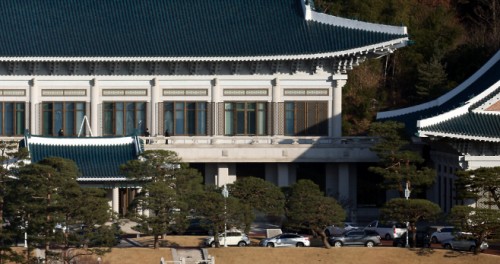 |
| Workers are seen cleaning the main building of Cheong Wa Dae on Feb. 12 as the presidential office begins relocating from Yongsan. /Park Sung-il |
Cheong Wa Dae has convened a series of emergency meetings to minimize the fallout from shifting U.S. tariff policies, pledging to move forward “without disruption” on planned investment in the United States.
The move comes after the U.S. Supreme Court ruled that the Donald Trump administration’s reciprocal tariffs were unlawful. Shortly after the ruling, however, the administration announced a new 10 percent global tariff under Section 122 of U.S. trade law and later signaled it could raise the rate to 15 percent, heightening trade uncertainty.
According to Cheong Wa Dae on Feb. 22, the Democratic Party of Korea, the government and the presidential office will hold a closed-door meeting at 8 p.m. in Samcheong-dong, Seoul, to assess pending trade issues and explore ways to reduce the “tariff shock.”
The presidential office had already convened an interagency meeting on Feb. 21, immediately after the U.S. Supreme Court ruling was made public. Both meetings are being chaired by Kim Yong-beom, presidential chief of policy, and Wi Sung-lac, national security adviser.
Presidential spokesperson Kang Yoo-jung said in a written briefing that while the court ruling invalidated the current 15 percent reciprocal tariff, the U.S. administration’s follow-up announcement of a 10 percent global tariff requires close monitoring of additional measures and developments in major countries.
Kang added that participants agreed to review the legislative progress of the proposed Special Act on Investment in the United States and to proceed with public hearings and other procedures without delay.
The legislation outlines plans for South Korea to invest a total of $350 billion in strategic U.S. industries, including $20 billion annually. Cheong Wa Dae appears to be pursuing a two-track strategy: implementing previously agreed tariff and investment commitments while carefully assessing Washington’s next steps and global reactions.
Officials believe a measured and cautious response is necessary amid renewed uncertainty in U.S. trade policy.
Trade tensions could also affect security and industrial cooperation areas where Seoul has already secured favorable terms from Washington, such as nuclear-powered submarine initiatives and most-favored-nation treatment for semiconductor tariffs. This has reinforced the administration’s view that honoring prior agreements with the Trump administration would be advantageous.
The meeting with party and government officials is also expected to urge swift passage of the special investment bill in the National Assembly.
Both ruling and opposition parties had previously agreed to expedite the legislation after Trump warned on Jan. 27 of possible tariff hikes, citing delays in Korea’s legislative process. However, tensions have resurfaced as the ruling party signaled plans to push forward three judicial reform bills, prompting the opposition to suggest it may withhold cooperation on the U.S. investment bill.
A senior presidential official said that if tariff hikes result from delays caused by opposition non-cooperation, “the opposition would bear greater responsibility, which would not be beneficial to them either.”
#Cheong Wa Dae #Donald Trump #U.S. Supreme Court #reciprocal tariffs #global tariff
Copyright by Asiatoday
Most Read
-
1
Trump shares map on social media labeling Strait o..

-
2
Kia Sportage outperforms Mazda CX-5 in German auto..

-
3
Houthis launch successive attacks on Saudi airport..

-
4
U.S. deploys carrier, 10,000 more troops to Middle..

-
5
Trump rejects Iran's offer to open Strait of Hormu..

-
6
N. Korea conducts first swarm attack drill with dr..

-
7
U.S.-China summit falls short on substance as Trum..

PEOPLE



HEADLINE NEWS
- Seoul dismisses Ukraine's claim of 'S. Korean support for Russia' as "inaccurate and inappropriate"
- S. Korea, Japan race to develop nuclear-powered submarines
- Henri Kagan, Kenso Soai win Nobel Prize in Chemistry for uncovering how mol..
- Vance says Alaska LNG cooperation will move forward with Seoul's current or..

-
Address : In-Young Bldg., 34, Uisadang-daero 1-gil, Yeongdeungpo-gu, Seoul
Copyright by ASIATODAY CO., LTD. All rights resereved