



Cooperation rhetoric fades as parties brace for showdown
Feb 19, 2026, 09:06 am


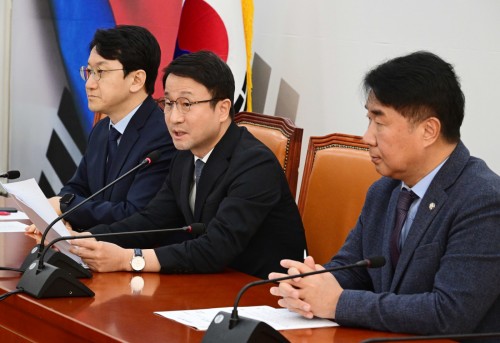 |
| Han Byung-do, floor leader of the Democratic Party of Korea, speaks at a press conference at the National Assembly on Feb. 18 regarding public sentiment during the Lunar New Year holiday and upcoming legislative tasks. /Lee Byung-hwa |
Rival parties that called for bipartisan cooperation during the Lunar New Year holiday are expected to remain locked in a hardline standoff through the end of the February parliamentary session, as sharp differences persist over controversial reform bills.
According to political sources on Feb. 18, the ruling Democratic Party of Korea and the opposition People Power Party are likely to confront each other once again over a series of contentious measures, particularly judicial reform bills.
Although both sides publicly emphasized “cooperation” during the holiday, many in political circles view such statements as little more than rhetoric.
Tensions had already surfaced before the holiday. The parties exchanged sharp words over judicial reform proposals — including bills to expand the number of Supreme Court justices, create a new crime of judicial distortion, and introduce a constitutional complaint system against court rulings.
Jang Dong-hyuk of the People Power Party boycotted a luncheon with President Lee Jae-myung and declared a boycott of a plenary session in protest. Although the parties had planned to pass around 80 livelihood-related bills at a plenary session on Feb. 12, only 63 were approved after the session was delayed.
The sharpest divide centers on judicial reform legislation. The People Power Party has labeled the bills “judicial destruction laws” and “legislation to save President Lee,” vowing to mobilize all available means — including a filibuster — if they are pushed through without bipartisan agreement.
Other bills remain stumbling blocks as well, including a special act to integrate South Chungcheong Province and Daejeon, and a third revision to the Commercial Act.
The proposed Commercial Act revision, which would mandate the cancellation of treasury shares, has drawn opposing views. The Democratic Party argues the measure is necessary to boost shareholder value and lay the groundwork for a “KOSPI 5000” era, while the People Power Party warns it could weaken corporate defenses against hostile mergers and acquisitions.
The Democratic Party plans to accelerate legislation by seeking to convene a plenary session on Feb. 24 and aims to process key reform and livelihood bills by early March. However, with the opposition expected to resort to a filibuster, it remains uncertain whether the bills can pass the full Assembly smoothly.
Han Byung-do said at a press briefing that public sentiment during the holiday reaffirmed demands for ending insurrection and pursuing broad social reform. “We will steadfastly pass judicial reform bills, the third Commercial Act revision, and the administrative integration special act,” he said. “We will mobilize all available means to complete livelihood and reform legislation.”
#Democratic Party of Korea #People Power Party #judicial reform bills
Copyright by Asiatoday
Most Read
-
1
Trump shares map on social media labeling Strait o..

-
2
Kia Sportage outperforms Mazda CX-5 in German auto..

-
3
Houthis launch successive attacks on Saudi airport..

-
4
U.S. deploys carrier, 10,000 more troops to Middle..

-
5
Trump rejects Iran's offer to open Strait of Hormu..

-
6
N. Korea conducts first swarm attack drill with dr..

-
7
U.S.-China summit falls short on substance as Trum..

PEOPLE






HEADLINE NEWS
- Seoul dismisses Ukraine's claim of 'S. Korean support for Russia' as "inaccurate and inappropriate"
- S. Korea, Japan race to develop nuclear-powered submarines
- Henri Kagan, Kenso Soai win Nobel Prize in Chemistry for uncovering how mol..
- Vance says Alaska LNG cooperation will move forward with Seoul's current or..

-
Address : In-Young Bldg., 34, Uisadang-daero 1-gil, Yeongdeungpo-gu, Seoul
Copyright by ASIATODAY CO., LTD. All rights resereved