



Lee: perks for multi-home owners encouraged speculation
Feb 19, 2026, 09:06 am


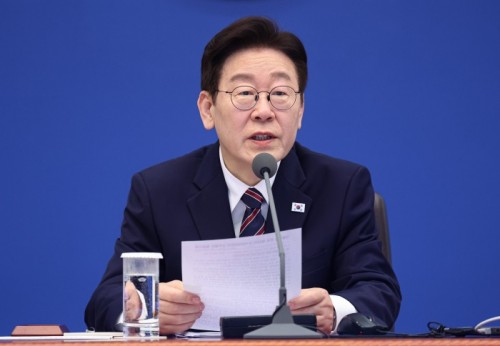 |
| President Lee Jae-myung speaks during a press event on Feb. 18. /Cheong Wa Dae Press Corps |
Lee Jae-myung on Feb. 18 shifted the focus of responsibility for real estate speculation to the political establishment, arguing that flawed institutional design — not merely individual ownership — enabled multi-home speculation.
In a post on X (formerly Twitter), Lee shared an article featuring criticism from Jang Dong-hyuk of the People Power Party, and said the distortion of the housing market stemmed from systems crafted and implemented by political authorities.
Rather than labeling multi-home ownership itself as a social evil, Lee suggested that the core issue lies in legal and institutional frameworks that incentivized speculative holding of multiple properties.
Earlier, Jang criticized Lee’s remarks on regulating multi-home owners, saying, “Demonizing them and provoking public resentment with a numbers game is amateur politics.”
In response, Lee wrote, “We cannot define multi-home ownership itself as a social evil. However, if politics — which holds the authority to design and enforce laws and institutions — failed to make undesirable multi-home ownership burdensome or prohibited, and instead granted special benefits that made it profitable and encouraged speculation, that is the problem.”
He added, “The law, as the minimum standard of morality, must be limited to what must be observed. Violations of such laws must be met with strict accountability so severe that no one would even dream of breaking them.”
The administration is reportedly considering additional fiscal and financial measures, including ending the temporary suspension of heavier capital gains taxes on multi-home owners and tightening loan regulations. The goal is to curb investment-driven demand and establish a housing market centered on genuine residential needs.
At the same time, Lee emphasized that not all multi-home ownership would be subject to regulation. “We will not take issue with a rural home where parents reside or a second home in a region at risk of depopulation,” he said. “We must distinguish between legitimate multi-home ownership and speculative multi-home ownership.”
Alongside housing policy, Lee is also pushing measures to ease everyday economic burdens. The government plans to accelerate efforts in areas directly affecting household expenses, such as reviewing pricing structures for daily necessities and normalizing school uniform prices. Officials are expected to focus policy capacity on monitoring whether price cuts in key items translate into tangible relief for consumers.
#Lee Jae-myung #housing policy #multi-home owners #People Power Party #Jang Dong-hyuk
Copyright by Asiatoday
Most Read
-
1
Trump shares map on social media labeling Strait o..

-
2
Kia Sportage outperforms Mazda CX-5 in German auto..

-
3
Houthis launch successive attacks on Saudi airport..

-
4
U.S. deploys carrier, 10,000 more troops to Middle..

-
5
Trump rejects Iran's offer to open Strait of Hormu..

-
6
N. Korea conducts first swarm attack drill with dr..

-
7
U.S.-China summit falls short on substance as Trum..

PEOPLE





HEADLINE NEWS
- Seoul dismisses Ukraine's claim of 'S. Korean support for Russia' as "inaccurate and inappropriate"
- S. Korea, Japan race to develop nuclear-powered submarines
- Henri Kagan, Kenso Soai win Nobel Prize in Chemistry for uncovering how mol..
- Vance says Alaska LNG cooperation will move forward with Seoul's current or..

-
Address : In-Young Bldg., 34, Uisadang-daero 1-gil, Yeongdeungpo-gu, Seoul
Copyright by ASIATODAY CO., LTD. All rights resereved