



Megaprojects signal turn to local growth
Jan 02, 2026, 08:48 am


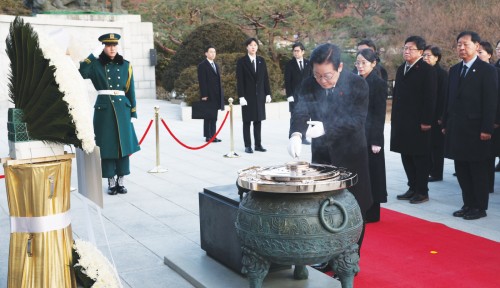 |
| President Lee Jae-myung offers incense at Seoul National Cemetery on New Year’s Day. / Yonhap |
President Lee Jae-myung on Thursday unveiled a sweeping shift in national strategy, placing regional-led growth at the center of his New Year agenda and signaling the launch of large-scale projects outside the capital region.
In his New Year address, Lee said the government would pivot from a Seoul-centric development model to empower regions as engines of growth. As part of the shift, major initiatives—including a “southern semiconductor belt” anchored in Gwangju (advanced packaging) and Busan (power semiconductors), a West Coast energy expressway, and AI data centers in South Jeolla Province and Pohang—are expected to move into full implementation this year.
Policies to strengthen regional public education, such as the administration’s flagship plan to create “10 Seouls National Universities,” are also set to enter a decisive phase.
“A complete paradigm shift to a five-pole, three-specialty system”
Lee said the transition from a “single-pole capital region” to a “five-pole, three-specialty” national structure is not a concession to localities but a prerequisite for Korea’s renewed growth. “The farther a region is from the capital, the thicker and bolder our support will be,” he said.
Calling last year’s relocation of the Ministry of Oceans and Fisheries only a beginning, Lee outlined a multipolar vision: Seoul as the economic capital, the central region as the administrative capital, and the southern region as a maritime capital. “From an energy-rich southern semiconductor belt to AI demonstration cities and renewable energy clusters, we will design a structure where advanced industries translate into regional prosperity,” he said.
Observers say Lee’s decision to make regional-led growth his first New Year priority reflects urgency over widening disparities between the capital and the rest of the country—an issue he has repeatedly emphasized after town hall meetings with local residents.
“Bold support for a startup and venture boom”
Lee also pledged a shift from growth concentrated in a handful of conglomerates to “growth for everyone,” aligning with the regional balance agenda. Pointing to benefits from trade talks and exports in defense and nuclear power accruing largely to big firms, he said economic gains achieved by society as a whole must flow to small and medium-sized enterprises, startups, and households.
“From the AI era to the energy transition, this moment of upheaval is an unlimited opportunity for innovators,” Lee said, promising aggressive support to usher in a boom for startups, venture firms, and SMEs.
On the Korean Peninsula, Lee reiterated his commitment to easing military tensions and rebuilding trust between the two Koreas, while coordinating with the international community. “As a pacemaker, we will actively support U.S.–North Korea dialogue and continue to seek restoration of inter-Korean relations,” he said.
Lee began the year by visiting Seoul National Cemetery with more than 20 Cabinet members, later sharing a New Year’s rice cake soup breakfast with attendees at the presidential office cafeteria.
#regional-led growth #national megaprojects #semiconductor belt #AI data centers #balanced development
Copyright by Asiatoday
Most Read
-
1
Trump shares map on social media labeling Strait o..

-
2
Kia Sportage outperforms Mazda CX-5 in German auto..

-
3
Houthis launch successive attacks on Saudi airport..

-
4
U.S. deploys carrier, 10,000 more troops to Middle..

-
5
Trump rejects Iran's offer to open Strait of Hormu..

-
6
N. Korea conducts first swarm attack drill with dr..

-
7
U.S.-China summit falls short on substance as Trum..

PEOPLE





HEADLINE NEWS
- Seoul dismisses Ukraine's claim of 'S. Korean support for Russia' as "inaccurate and inappropriate"
- S. Korea, Japan race to develop nuclear-powered submarines
- Henri Kagan, Kenso Soai win Nobel Prize in Chemistry for uncovering how mol..
- Vance says Alaska LNG cooperation will move forward with Seoul's current or..

-
Address : In-Young Bldg., 34, Uisadang-daero 1-gil, Yeongdeungpo-gu, Seoul
Copyright by ASIATODAY CO., LTD. All rights resereved