



Hanwha rises as hub of US shipbuilding revival
Dec 26, 2025, 08:56 am


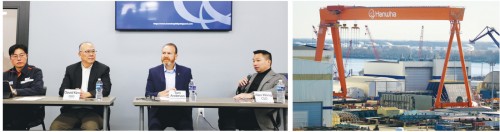 |
| Executives from Hanwha Group speak during a media briefing at Hanwha Philly Shipyard in Philadelphia, Pennsylvania, on Dec. 22. The facility is emerging as a key hub in U.S. shipbuilding revitalization efforts. / Philadelphia = Correspondent Ha Man-joo |
Hanwha Group is positioning itself as a central player in the United States’ drive to revive its shipbuilding industry, with its Philadelphia shipyard emerging as a key operational base for Washington’s plan to restore naval power under President Donald Trump’s so-called “Golden Fleet” initiative.
Hanwha hosted a media day on Dec. 22 at its Hanwha Philly Shipyard in Pennsylvania, showcasing not just facilities but what executives described as a ready-to-execute platform aligned with U.S. national strategy to rebuild shipbuilding capacity and strengthen naval forces.
The significance of the site was underscored the same day when Trump publicly announced his Golden Fleet vision — aimed at countering China’s expanding naval power — and explicitly cited cooperation with South Korean conglomerate Hanwha. Trump recalled that during World War II, the United States built more than four ships a day on average, vowing to restore that capability.
Industry officials say the Philadelphia shipyard represents the point where political ambition meets practical execution.
Tom Anderson, head of shipbuilding at Hanwha Defense USA, said the shipyard should be seen not as a future possibility but as a fully prepared asset. The Golden Fleet concept centers on large, potentially nuclear-capable platforms and advanced surface vessels, while also elevating domestic production capacity as a political priority.
Rather than limiting cooperation to a single frigate program, Anderson said Hanwha is targeting the U.S. Navy’s core platform — the Virginia-class nuclear-powered submarine. “Hanwha Philly Shipyard has the capability to build nuclear-powered submarines,” he said, stressing that readiness extends beyond any single model to the entire class of nuclear-propulsion platforms.
The U.S. Navy currently requires two submarines per year but produces only about 1.2 due to capacity bottlenecks. To address this gap, Anderson proposed leveraging proven designs instead of starting from scratch, applying South Korea’s shipbuilding expertise in shortening construction timelines to the Virginia-class framework.
Acknowledging the complexity of nuclear submarine construction, Anderson outlined key prerequisites: workforce expansion, deployment of skilled Korean technicians, recruitment of personnel with Virginia-class experience, and close coordination with the U.S. Navy’s Naval Reactors program.
On the sensitive issue of nuclear material control, Anderson drew clear boundaries. “The reactor compartment is provided by the U.S. government,” he said, adding that strict safeguards and procedures for nuclear material management are already in place. Hanwha, he said, would comply with the same standards applied to all U.S. nuclear-submarine shipyards.
Questions at the briefing focused on timing. While declining to commit to a specific schedule, Anderson emphasized Hanwha’s readiness to move quickly once government decisions are made. “We fully recognize the urgency of submarine production,” he said.
Supply-chain resilience also emerged as a key theme. Anderson said Hanwha plans to integrate South Korea’s robust shipbuilding supply network to stabilize schedules and accelerate delivery, while maintaining the principle of “Made in the USA” production. In effect, Korean suppliers would serve as the arteries supporting U.S.-built vessels.
Cho Jong-woo, head of Hanwha Philly Shipyard, said expanded shipbuilding in the United States would allow Korean component makers and partner firms to enter global supply chains and grow alongside the U.S. naval buildup.
As Washington seeks to turn shipbuilding revival from slogan into strategy, Hanwha’s U.S. foothold is increasingly viewed as a critical pillar in rebuilding America’s maritime power.
#Hanwha Group #US shipbuilding #Golden Fleet #Hanwha Philly Shipyard #US Navy
Copyright by Asiatoday
Most Read
-
1
Kia Sportage outperforms Mazda CX-5 in German auto..

-
2
Houthis launch successive attacks on Saudi airport..

-
3
Saudi Arabia, Iran hold first diplomatic talks to..

-
4
U.S. deploys carrier, 10,000 more troops to Middle..

-
5
Saudi airport in Riyadh struck again, leaving at l..

-
6
Putin's ally visits China on the 8th ahead of APEC..

-
7
Chinese military support and training center opens..

PEOPLE






HEADLINE NEWS

-
Address : In-Young Bldg., 34, Uisadang-daero 1-gil, Yeongdeungpo-gu, Seoul
Copyright by ASIATODAY CO., LTD. All rights resereved