



Think tanks see Seoul home prices rising
Dec 24, 2025, 09:17 am


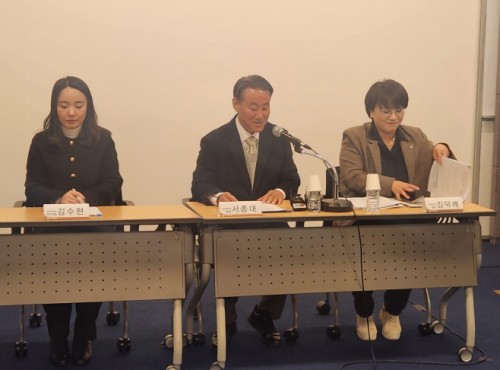 |
| From left, Kim Soo-hyun, senior research fellow; Seo Jong-dae, president; and Kim Deok-rye, head of the Housing Policy Research Division at the Housing Industry Research Institute, speak at a seminar on “2026 Housing Market Outlook and Policy Directions” held at the Korea Chamber of Commerce and Industry in Seoul on Dec. 23. / Photo by Jeon Won-jun |
Major South Korean real estate research institutes are forecasting further gains in Seoul and metropolitan-area home prices next year, citing rising liquidity and a deepening supply shortage despite tighter government regulations.
The Housing Industry Research Institute (HIRI) said Tuesday that Seoul’s housing transaction prices are expected to rise 4.2% next year, presenting its outlook at a seminar titled “2026 Housing Market Outlook and Policy Directions” held at the Korea Chamber of Commerce and Industry in Seoul.
The projection is more than double the institute’s forecast for this year’s Seoul price growth, previously estimated at 1.7%. HIRI also expects nationwide home prices to rise 1.3%, with the Seoul metropolitan area projected to see a 2.5% increase.
The forecast follows similar assessments released last month by the Korea Construction Industry Research Institute and the Korea Construction Policy Research Institute, which predicted price gains of around 2.0% and 2.3%, respectively, for the greater Seoul area.
Although those institutes did not publicly disclose separate projections for Seoul, industry officials said price trends in the capital are widely viewed as the main driver of metropolitan-area gains. A researcher at the Construction Industry Research Institute said HIRI’s outlook “does not appear unreasonable,” noting that internal estimates were withheld due to concerns over market impact.
The institutes cited multiple upward pressures, including persistent liquidity growth, delays in housing supply, project financing risks, and higher construction costs that have dampened private-sector development. According to HIRI, the broad money supply (M2) reached 4,466 trillion won as of October, up sharply from 2,626 trillion won in 2018 and 3,722 trillion won in 2022.
Seo Jong-dae, president of HIRI, said the rapid expansion of liquidity has “continued to accumulate upward pressure on asset prices, including real estate.”
Supply constraints are also expected to intensify. Government estimates show a cumulative shortfall of about 600,000 housing starts over the past four years due to delays in permits and construction. Data from real estate platform Zigbang indicate that Seoul’s apartment move-in volume next year will fall to 16,412 units, a 48% drop from this year.
Kim Deok-rye, head of HIRI’s Housing Policy Research Division, urged the government to play a more active role in stabilizing the market by managing liquidity, easing unintended side effects of regulations, and expanding housing supply. She also called for adjustments to overly stringent interim and balance-payment loan rules for first-time and end-user homebuyers.
#Seoul housing prices #housing market outlook #Housing Industry Research Institute
Copyright by Asiatoday
Most Read
-
1
Celltrion nears additional contract with major U.S..

-
2
Houthis launch successive attacks on Saudi airport..

-
3
Saudi Arabia, Iran hold first diplomatic talks to..

-
4
Saudi airport in Riyadh struck again, leaving at l..

-
5
"Aren't those foreigners on welfare?": M..

-
6
U.S. deploys carrier, 10,000 more troops to Middle..

-
7
Five ASEAN countries welcome Myanmar coup leader

PEOPLE







-
Address : In-Young Bldg., 34, Uisadang-daero 1-gil, Yeongdeungpo-gu, Seoul
Copyright by ASIATODAY CO., LTD. All rights resereved