



Half of firms see tough business climate next year
Dec 23, 2025, 08:21 am


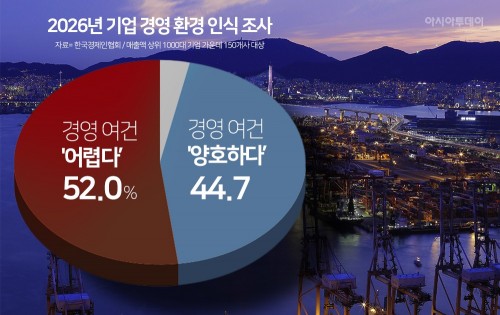 |
| Data from the Korea Economic Association of Business shows survey results on corporate outlook for next year. / Graphic by Park Jong-gyu |
More than half of South Korea’s major companies expect business conditions next year to be difficult, citing prolonged domestic demand weakness and heightened exchange-rate volatility as key sources of uncertainty.
According to the Korea Economic Association of Business, 52.0% of respondents in its “2026 Corporate Business Environment Survey” said they foresee challenging management conditions next year. The survey covered 150 companies selected from the nation’s top 1,000 firms by sales. By contrast, 44.7% described the outlook as favorable, meaning pessimistic views outweighed optimistic ones.
The biggest source of perceived uncertainty was sluggish domestic demand. About 32.2% of respondents pointed to “domestic demand contraction and delayed recovery” as the top internal risk, reflecting concerns that prolonged high interest rates and subdued consumption are weighing on sales recovery. Rising inflation and delays in interest rate cuts followed as additional factors.
On the external front, 26.7% cited volatility in foreign exchange markets as the most significant risk, while 24.9% pointed to stronger protectionism and expanding export barriers. Companies warned that a prolonged period of high exchange rates could translate into higher costs and weaker profitability.
Industry officials said the combined impact of weak domestic demand and currency volatility is creating a double burden on corporate management. Export-oriented manufacturers, in particular, are increasingly concerned that exchange-rate swings could affect not only short-term earnings but also medium- to long-term investment and employment decisions.
The association assessed that business conditions are unlikely to improve rapidly next year, with uncertainty expected to persist amid a global economic slowdown, geopolitical risks and changes in the international trade environment. As a result, companies are likely to maintain a cautious management stance.
At the same time, firms are expected to pursue survival strategies in an increasingly competitive global landscape, while responding to fast-changing trends such as artificial intelligence adoption and carbon neutrality. Restructuring core businesses and diversifying business portfolios are also forecast as key strategies to bolster competitiveness.
Lee Sang-ho, head of the economic and industrial policy division at the association, said companies are facing significant pressure from unstable external conditions and delayed domestic recovery. He stressed the need for the government to push forward bold regulatory reforms, along with stronger support for advanced and emerging industries, and to accelerate policies aimed at boosting domestic demand and exports.
Industry sources added that since management uncertainty is rooted in structural factors, policy consistency and predictability are crucial. They emphasized that beyond short-term stimulus measures, comprehensive regulatory reforms and efforts to stabilize financial and foreign exchange markets are needed to restore business confidence.
#business outlook #corporate survey #domestic demand slowdown #exchange rate volatility #management uncertainty
Copyright by Asiatoday
Most Read
-
1
Kia Sportage outperforms Mazda CX-5 in German auto..

-
2
Houthis launch successive attacks on Saudi airport..

-
3
Saudi Arabia, Iran hold first diplomatic talks to..

-
4
U.S. deploys carrier, 10,000 more troops to Middle..

-
5
Saudi airport in Riyadh struck again, leaving at l..

-
6
Putin's ally visits China on the 8th ahead of APEC..

-
7
Chinese military support and training center opens..

PEOPLE






HEADLINE NEWS

-
Address : In-Young Bldg., 34, Uisadang-daero 1-gil, Yeongdeungpo-gu, Seoul
Copyright by ASIATODAY CO., LTD. All rights resereved