



Coupang hearing derailed without Kim Beom-su
Dec 18, 2025, 08:59 am


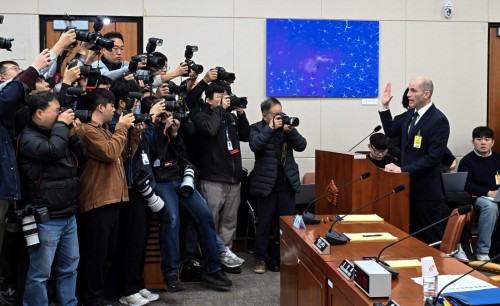 |
| Harold Rogers, interim CEO of Coupang (right), takes an oath as a witness during a parliamentary hearing on a Coupang personal data breach at the National Assembly on December 17. / Photo by Song Ui-joo |
A National Assembly hearing into Coupang’s massive personal data breach ended in what lawmakers described as an “empty” session, after key executives failed to appear. Angered by what they called Coupang’s passive response, parliamentarians vowed tougher measures, including a national investigation and legislation to bar entry into South Korea.
On December 17, the National Assembly’s Science, ICT, Broadcasting and Communications Committee held a hearing on the Coupang data leak. Those who appeared included Harold Rogers, Coupang’s interim CEO; Brad Mathis, the company’s chief information security officer; and Min Byung-gi, executive vice president in charge of external relations. Missing, however, were Coupang Inc. Chairman Kim Beom-su, former CEO Park Dae-joon, and overall operations chief Kang Han-seung — often referred to as Coupang’s “core trio.”
While pledging to take a “responsible stance” over the breach, Coupang characterized the incident as a “limited issue.” Rogers said the leaked data did not include sensitive information such as payment or login details, adding that “the scope was smaller than other data breaches that occurred over the past 18 months.”
In a filing submitted to the U.S. Securities and Exchange Commission shortly before the hearing, Coupang described the incident as a “material cybersecurity event,” but added that it “did not materially disrupt operations.”
Rogers explained that “under SEC rules, the incident does not meet the threshold for mandatory disclosure,” saying the filing was made “to prevent information asymmetry for U.S. investors.”
Lawmakers from both the ruling and opposition parties reacted furiously, warning they would “see this through to the end.” Following the hearing, the committee decided to pursue a national investigation, which allows for comprehensive inquiries lasting up to 60 days and includes the power to issue compulsory summons — unlike hearings, which are typically brief.
Separately, the National Assembly’s Strategy and Finance Committee held a plenary session the same day and decided to file a complaint against Chairman Kim for violating the Act on Testimony and Appraisal before the National Assembly due to his failure to appear. In addition, the Democratic Party introduced a bill dubbed the “Kim Beom-su entry ban law,” citing Kim’s overseas residence and frequent foreign travel. The bill would bar foreign nationals from entering South Korea if they fail to appear without just cause after being summoned as witnesses by the National Assembly or its committees.
#Coupang #data breach #National Assembly hearing #Kim Beom-su #national investigation
Copyright by Asiatoday
Most Read
-
1
Trump shares map on social media labeling Strait o..

-
2
Kia Sportage outperforms Mazda CX-5 in German auto..

-
3
Houthis launch successive attacks on Saudi airport..

-
4
U.S. deploys carrier, 10,000 more troops to Middle..

-
5
Trump rejects Iran's offer to open Strait of Hormu..

-
6
N. Korea conducts first swarm attack drill with dr..

-
7
U.S.-China summit falls short on substance as Trum..

PEOPLE






HEADLINE NEWS
- Seoul dismisses Ukraine's claim of 'S. Korean support for Russia' as "inaccurate and inappropriate"
- S. Korea, Japan race to develop nuclear-powered submarines
- Henri Kagan, Kenso Soai win Nobel Prize in Chemistry for uncovering how mol..
- Vance says Alaska LNG cooperation will move forward with Seoul's current or..

-
Address : In-Young Bldg., 34, Uisadang-daero 1-gil, Yeongdeungpo-gu, Seoul
Copyright by ASIATODAY CO., LTD. All rights resereved