



Lee vows swift rewards for top civil servants
Dec 17, 2025, 09:50 am


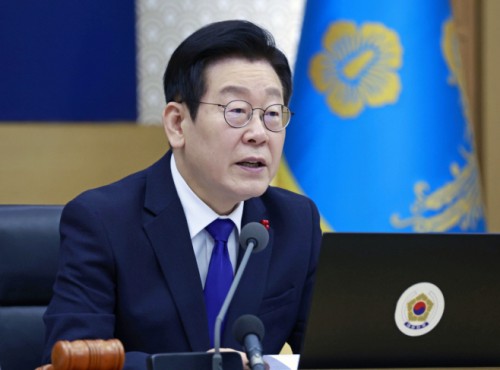 |
| President Lee Jae-myung speaks during a Cabinet meeting at the Government Complex Sejong on December 16. / Source: Yonhap News |
President Lee Jae-myung on December 16 instructed government ministries to move quickly to introduce bold rewards for civil servants who deliver outstanding performance, citing the growing complexity of administrative demands and the need to boost morale in the public sector.
Speaking at the 54th Cabinet meeting held at the Government Complex Sejong, Lee said administrative workloads are expanding while improvements in working conditions for public officials have failed to keep pace. He called for swift follow-up measures to ensure that “exceptional dedication and results are met with commensurate, unconventional compensation.”
“Public servants should be able to take pride in their work,” Lee said, pledging special rewards for extraordinary commitment and achievements. He also ordered ministries to continue studying and reviewing additional measures to improve conditions across the civil service.
Lee stressed that both policy design and effective implementation depend on the dedication, passion and sense of responsibility of public officials. “Korea has reached where it is today because there are civil servants in the field who faithfully and conscientiously carry out their roles,” he said, offering words of encouragement.
The president also urged officials to quickly adapt to the government’s new practice of livestreaming policy briefings. While acknowledging that the format may feel unfamiliar, Lee said transparent scrutiny of the policy process and the pooling of collective intelligence would enhance public trust and the overall quality of governance.
“For a truly people-centered administration, policy processes must be openly shared with the public,” he said, adding, “With practice, it will get better.”
In addition, Lee called for building an economic ecosystem that promotes solidarity and cooperation to address polarization. He asked relevant ministries to thoroughly explore ways to revitalize the social economy across areas such as cooperatives, education, culture and the arts, care services, healthcare, and climate and energy.
“Building institutions, refining governance and discovering new policies are all necessary,” Lee said. “Doing nothing is bad, but moving so slowly that it is unclear whether anything is being done is also undesirable. Swift decision-making and policy formulation are essential.”
#Lee Jae-myung #Cabinet meeting #civil servants #performance rewards #public sector reform
Copyright by Asiatoday
Most Read
-
1
Trump shares map on social media labeling Strait o..

-
2
Kia Sportage outperforms Mazda CX-5 in German auto..

-
3
Houthis launch successive attacks on Saudi airport..

-
4
U.S. deploys carrier, 10,000 more troops to Middle..

-
5
Trump rejects Iran's offer to open Strait of Hormu..

-
6
N. Korea conducts first swarm attack drill with dr..

-
7
U.S.-China summit falls short on substance as Trum..

PEOPLE






HEADLINE NEWS
- Seoul dismisses Ukraine's claim of 'S. Korean support for Russia' as "inaccurate and inappropriate"
- S. Korea, Japan race to develop nuclear-powered submarines
- Henri Kagan, Kenso Soai win Nobel Prize in Chemistry for uncovering how mol..
- Vance says Alaska LNG cooperation will move forward with Seoul's current or..

-
Address : In-Young Bldg., 34, Uisadang-daero 1-gil, Yeongdeungpo-gu, Seoul
Copyright by ASIATODAY CO., LTD. All rights resereved