



ROK–U.S. launch fact sheet follow-up talks
Dec 17, 2025, 09:46 am


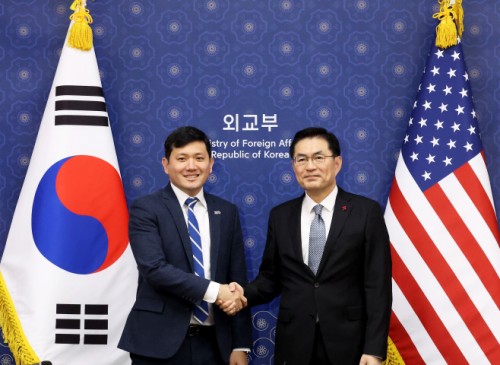 |
| Jung Yeon-doo (right), director general for foreign policy and intelligence at South Korea’s Foreign Ministry, shakes hands with Kevin Kim, chargé d’affaires at the U.S. Embassy in Seoul, during follow-up consultations on the joint fact sheet from the ROK–U.S. summit at the ministry in Jongno District, Seoul, on December 16. / Pool photo |
South Korean and U.S. diplomatic authorities held their first follow-up meeting to coordinate North Korea policy based on the joint fact sheet issued after the recent ROK–U.S. summit.
Jung Yeon-doo, director general for foreign policy and intelligence at South Korea’s Foreign Ministry, met Kevin Kim, chargé d’affaires at the U.S. Embassy in Seoul, at the ministry headquarters in Jongno District on December 16 for the “ROK–U.S. Consultation on Joint Fact Sheet Implementation.”
On the South Korean side, participants included Baek Yong-jin, director general for Korean Peninsula policy; Seo Ki-won, director of the North Korea policy cooperation division; Kim Sang-il, director of the North Korean nuclear policy division; and Kim Dae-sik, director of the Korean Peninsula future policy division. The U.S. delegation included Scott Johnson, the Pentagon’s Korea desk chief; Brian Cox, a senior intelligence analyst at the State Department’s Bureau of Intelligence and Research; Dan Chitron, acting deputy assistant secretary for East Asian and Pacific affairs; and Maria Sand, head of the State Department’s North Korea team. Officials from both countries’ militaries also attended.
The Foreign Ministry said the two sides held comprehensive discussions on issues related to the Korean Peninsula based on the joint fact sheet from the leaders’ summit.
North Korea-related items outlined in the document include reaffirming the commitment to the complete denuclearization of North Korea and peace and stability on the Korean Peninsula; cooperation to implement the 2018 Singapore Joint Statement; close coordination on North Korea policy; and urging Pyongyang to return to dialogue and comply with international obligations by abandoning its weapons of mass destruction and ballistic missile programs.
The ministry said both sides agreed on the importance of close coordination in pursuing future Korea Peninsula policy and decided to further strengthen communication at all levels.
Addressing speculation about differing views within the South Korean government over North Korea policy, the ministry said the government is operating as “one team,” maintaining close consultation and communication across foreign and security agencies. It added that, with dialogue with North Korea currently stalled, the Foreign Ministry and the Unification Ministry are working closely to create conditions to reopen talks and will continue to do so.
Foreign Ministry spokesperson Park Il said the most important bilateral agreement is the joint fact sheet from the ROK–U.S. summit, calling its faithful implementation a whole-of-government task. He said the ministry will maintain necessary diplomatic communication with Washington to ensure successful implementation of the peninsula-related elements, while continuing close coordination with relevant ministries.
#ROK–U.S. relations #joint fact sheet #North Korea policy #denuclearization #Singapore Joint Statement
Copyright by Asiatoday
Most Read
-
1
Trump shares map on social media labeling Strait o..

-
2
Kia Sportage outperforms Mazda CX-5 in German auto..

-
3
Houthis launch successive attacks on Saudi airport..

-
4
U.S. deploys carrier, 10,000 more troops to Middle..

-
5
Trump rejects Iran's offer to open Strait of Hormu..

-
6
N. Korea conducts first swarm attack drill with dr..

-
7
U.S.-China summit falls short on substance as Trum..

PEOPLE






HEADLINE NEWS
- Seoul dismisses Ukraine's claim of 'S. Korean support for Russia' as "inaccurate and inappropriate"
- S. Korea, Japan race to develop nuclear-powered submarines
- Henri Kagan, Kenso Soai win Nobel Prize in Chemistry for uncovering how mol..
- Vance says Alaska LNG cooperation will move forward with Seoul's current or..

-
Address : In-Young Bldg., 34, Uisadang-daero 1-gil, Yeongdeungpo-gu, Seoul
Copyright by ASIATODAY CO., LTD. All rights resereved