



Wiles lifts veil on Trump’s power dynamics
Dec 17, 2025, 09:29 am


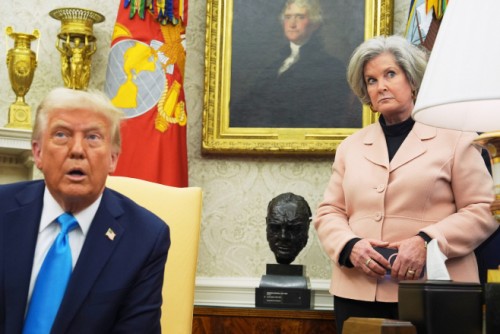 |
| White House Chief of Staff Susie Wiles (right) attends a meeting between U.S. President Donald Trump and Israeli Prime Minister Benjamin Netanyahu in the Oval Office on February 4. / Source: AP via Yonhap News |
An interview in which White House Chief of Staff Susie Wiles laid bare the inner workings of what she called “Trump World” has sent shockwaves through Washington, offering a rare look at decision-making, internal rivalries and the opening moves of a potential 2028 succession battle.
Wiles—President Donald Trump’s closest aide and longtime campaign strategist—has been known as the “Ice Maiden” for enforcing discipline in the West Wing and as a publicity-shy power broker. Yet during the first year of Trump’s second term, she sat for 11 interviews with Vanity Fair, discussing core issues ranging from pardons and retaliation to tariffs and a Venezuela operation.
The interviews are being viewed less as a tell-all than as a preview of how Trump’s second-term agenda is forged—and how future power struggles may unfold.
‘An alcoholic personality’ and politics of retaliation
Wiles described Trump as someone who does not drink but possesses what she called “an alcoholic personality,” saying he acts with the belief that “there is nothing—zero—he cannot do.”
Citing her own family history, she said she has become “something of an expert” on people with “big personalities,” adding that traits associated with alcoholism tend to be magnified when drinking is involved.
Trump appeared to accept the characterization. Speaking to the New York Post, he said he had once described himself the same way, referencing his brother’s alcoholism and saying he was “lucky” not to drink because he has a possessive, addictive personality. Asked whether he still trusted Wiles, Trump replied: “Oh, she’s fantastic.”
Wiles also said one of her core tasks has been managing Trump’s desire for retribution. She said they loosely agreed to wrap up “score-settling” within the first 90 days of the second term, but acknowledged that some prosecutions appeared at least partly driven by that impulse. “In some cases, it can look like retaliation,” she said, adding, “Who can blame him? I don’t.”
Clashes over pardons, tariffs and deportations
Wiles said she tried—and failed—to restrain Trump on some of his most controversial decisions, including pardons for Jan. 6 rioters, sweeping tariffs and mass deportations.
She urged against pardoning the most violent participants in the Capitol attack and recommended delaying tariff announcements because of “huge disagreement” among advisers. Trump pressed ahead, and Wiles said the impact of tariffs proved “more painful than expected.”
On deportations, she cited a case in which a woman with U.S.-citizen children was removed, saying she could not understand how such an error occurred and conceding flaws in implementation.
Epstein files: ‘Whiffed’
Wiles sharply criticized Attorney General Pam Bondi—also a friend—over her handling of matters related to the late Jeffrey Epstein, calling it a complete “whiffed.”
She said Bondi fueled expectations by handing influencers “binders full of nothingness” and suggesting a list was on her desk. “There is no such client list, and it certainly wasn’t on her desk,” Wiles said.
She also rejected Trump’s long-standing claim that former President Bill Clinton visited Epstein’s island, saying there is no evidence and that Trump “was wrong on that.”
Assessing Trump’s inner circle—and 2028
Wiles offered unusually blunt assessments of senior figures. She labeled Vice President J.D. Vance “a conspiracy theorist for 10 years,” saying his shift toward Trump was a political conversion. By contrast, she said Secretary of State Marco Rubio “is not the kind of person who violates his principles,” suggesting his support for Trump was hard-won.
The New York Times said the remarks point to a “quiet rivalry” over the post-Trump future, interpreting Wiles’s comments as signaling greater favor toward Rubio than Vance among MAGA voters.
She described Office of Management and Budget Director Russell Vought as “a right-wing absolute zealot,” and Tesla CEO Elon Musk—who led the Department of Government Efficiency early in the term—as a “genius but an odd duck,” referring to him as an “avowed ketamine user.” Wiles said she was initially “appalled” by the “evisceration” of the U.S. Agency for International Development, stressing that aid workers “do very good work.”
Venezuela: ‘Regime change’
Wiles said the Trump administration’s actions near Venezuela—including strikes on drug-trafficking vessels and the seizure of tankers—are aimed less at interdiction than at “regime change” against President Nicolás Maduro.
“He wants to keep blowing up boats until Maduro cries uncle,” she said, while drawing a line at attacks inside Venezuelan territory, which she said would require congressional authorization.
Pushback and fallout
After publication, Wiles wrote on X that the article was “dishonestly constructed” and ignored key context, accusing it of advancing a negative narrative about the president and his team.
White House press secretary Karoline Leavitt said there is “no better or more loyal aide” to Trump than Wiles and that the administration “fully supports her.”
Ram Emanuel, a former White House chief of staff under President Barack Obama, said he initially thought the interview was satire. “I’ve never seen a sitting chief of staff give such a candid interview,” he said, adding a pointed warning: “Next time you have dinner, bring a food taster.”
#Susie Wiles #Donald Trump #White House chief of staff #Vanity Fair interview #2028 succession
Copyright by Asiatoday
Most Read
-
1
Celltrion’s Omlyclo gains ground in major European..

-
2
Trump demands rates fall below 1% as Fed hikes for..

-
3
Trump makes $1 trillion bet ahead of midterm elect..

-
4
Iran resumes ballistic missile production, assembl..

-
5
Samsung Electronics, Mistral AI to jointly develop..

-
6
Trump warns countries not helping U.S. must pay re..

-
7
Apple launches first foldable, 1 million won prici..

PEOPLE






HEADLINE NEWS
- Trump to roll out ‘unprecedented welcome’ for Xi with B-2 bombers, F-22 fighters
- S. Korea, U.S., and Japan form united front on Taiwan and economic coercion..
- Trump administration moves to impose sweeping sanctions on International Cr..
- Xi to make state visit to U.S. Sept. 23-25, dispelling rumors over his heal..

-
Address : In-Young Bldg., 34, Uisadang-daero 1-gil, Yeongdeungpo-gu, Seoul
Copyright by ASIATODAY CO., LTD. All rights resereved