



Russia reportedly preparing to launch nuclear-armed satellite
Nov 24, 2026, 10:41 am


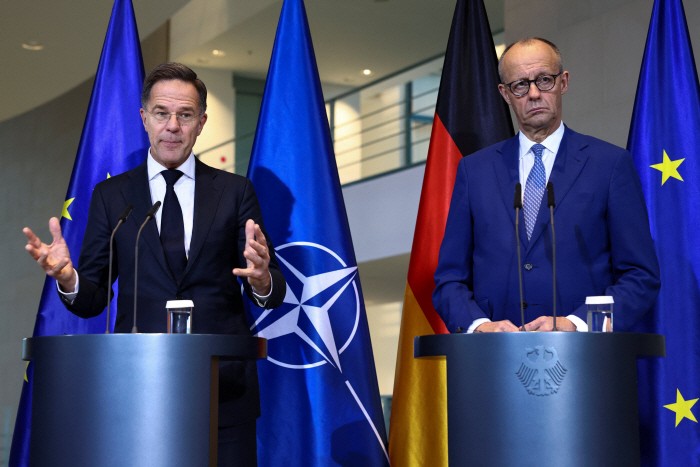 |
| German Chancellor Friedrich Merz (right) and NATO Secretary General Mark Rutte hold a joint press conference at the Federal Chancellery in Berlin, Germany, on November 23 (local time). / Reuters-Yonhap |
Western intelligence agencies have assessed that Russia is preparing to launch a satellite carrying a nuclear weapon.
According to German public broadcasters NDR and WDR and the daily newspaper Süddeutsche Zeitung on November 23 (local time), Germany's Federal Intelligence Service (BND) and armed forces shared intelligence indicating that a Russian satellite known as Sputnik-S had been assembled several years ago and deployed in the Moscow region.
A warning issued earlier this month indicated that the satellite could be launched within 60 days and become operational immediately afterward. British daily The Guardian reported that German military authorities were reportedly preparing for a possible launch in December.
If a satellite carrying a nuclear weapon were actually placed in Earth orbit, it would constitute a violation of the 1967 Outer Space Treaty and the 1963 Partial Nuclear Test Ban Treaty (PTBT), to which Russia is a signatory. The two treaties prohibit the deployment of nuclear weapons in Earth orbit and nuclear test explosions in outer space.
In an interview with Politico earlier this year, Michael Traut, commander of Germany's Space Command, said the possibility that Russia was developing technology to deploy a nuclear explosive device in Earth orbit could not be ruled out. He warned that a nuclear explosion in space could affect up to one-third of satellites in low Earth orbit, disrupt satellite services and render the orbit unusable for decades.
The German government said it was closely monitoring the matter with grave concern. The North Atlantic Treaty Organization (NATO) also stressed the importance of reviewing its defense posture. At a joint press conference with German Chancellor Friedrich Merz that day, NATO Secretary General Mark Rutte said the alliance was constantly assessing its deterrence and defense posture and would safeguard all NATO territory, including in the space domain.
Russia categorically denied the reports. Kremlin spokesperson Dmitry Peskov said he had not seen the reports and dismissed them, saying there were numerous speculative claims from unclear sources that were not worth taking seriously.
Disputes between Russia and the United States and other Western countries over the militarization of space have continued for several years. U.S. authorities previously raised the possibility that Russia's experimental satellite Cosmos 2553, launched in 2022, was part of preliminary testing for the deployment of nuclear weapons in space.
In 2024, the United States claimed that Russia was developing a weapon capable of disabling satellite networks such as Starlink through an electromagnetic pulse (EMP) generated by a nuclear explosion in space.
At the time, U.S. President Joe Biden and White House National Security Council (NSC) National Security Communications Advisor John Kirby expressed concern over Russia's development of anti-satellite weapons, while Russian President Vladimir Putin denied the claims.
Lee Jeong-eun
Most Read
-
1
AMD's Lisa Su floated as potential Nvidia successo..

-
2
China President Xi's Keynote Speech at the APEC C..

-
3
Alice Huang, affair partner of Jensen Huang, repor..

-
4
Iran resumes attacks after two months, targeting U..

-
5
Russian warship sinks in suspected drone attack at..

-
6
Inside Kylin Villa, the symbol of China's reform h..

-
7
Trump, Xi, Putin call for security cooperation at..

PEOPLE







-
Address : In-Young Bldg., 34, Uisadang-daero 1-gil, Yeongdeungpo-gu, Seoul
Copyright by ASIATODAY CO., LTD. All rights resereved