



Japan seeks to bolster infrastructure resilience and AI sovereignty in security strategy
Nov 24, 2026, 10:31 am


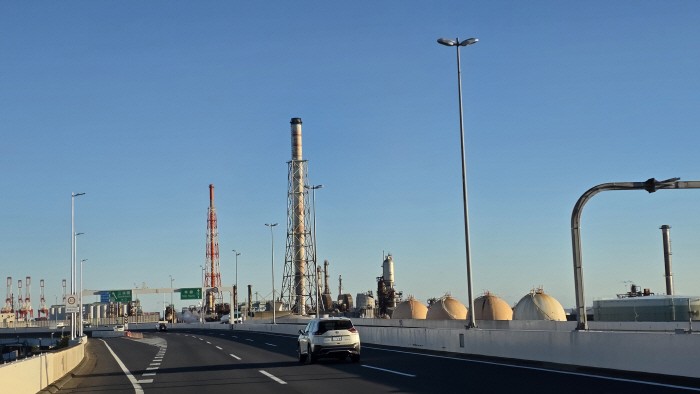 |
| Storage tanks and industrial facilities in a coastal industrial zone are visible beyond the Bayshore Route of the Metropolitan Expressway near Honmoku in Yokohama, Kanagawa Prefecture, Japan. The Japanese government plans to include measures for the rapid restoration of roads and industrial infrastructure damaged by attacks in its three key security documents, which are set to be revised in December. / Yokohama = Choi Young-jae, Tokyo correspondent |
The Japanese government plans to incorporate into its national security strategy a framework for rapidly restoring critical infrastructure, including roads and power plants, in the event of attacks. It also plans to diversify its sources of rare earths in response to China's export restrictions and establish "AI sovereignty" as a new objective to avoid excessive reliance on foreign artificial intelligence (AI) technology.
The Yomiuri Shimbun reported on November 24 that the Japanese government had included these measures in a draft outline of the economic security provisions of its three key security documents, which are scheduled to be revised in December. The three documents comprise the National Security Strategy, the National Defense Strategy and the Defense Buildup Program. The proposals are currently at the draft outline stage. The government plans to finalize the details following discussions with an expert panel and consultations with the ruling party.
The central objective is to develop not only the ability to prevent attacks but also the capacity to rapidly restore normal life in their aftermath. The draft outline refers to this capability as "resilience." The plan calls for securing in advance the personnel, materials and industrial capacity needed to restore roads and power plants if they are destroyed, while preparing alternative sources of essential goods in case imports are disrupted.
The Japanese government has drawn lessons from Ukraine, which has been fighting a protracted war following Russia's invasion. Ukraine has continued restoration work even after roads and power plants have been destroyed, sustaining the daily lives of its citizens. The Japanese government plans to explicitly state in the revised documents its assessment that maintaining people's livelihoods and industrial activity is essential for the Self-Defense Forces (SDF) to sustain their operations over an extended period. In effect, the government views economic security as a foundation supporting military operations.
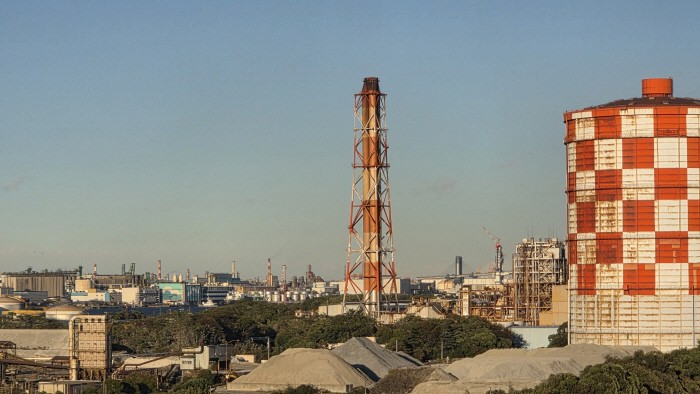 |
| Chimneys and large industrial facilities line a coastal industrial zone near Yokohama, Japan. The Japanese government plans to include measures for the rapid restoration of industrial infrastructure damaged by attacks in its three key security documents, which are set to be revised in December. / Yokohama = Choi Young-jae, Tokyo correspondent |
Preparations span rare earth procurement to data center security
The supply chain measures take into account China's rare earth export restrictions. Japan plans to work with friendly countries to diversify sources of materials such as rare earths for which it is heavily dependent on specific countries, while strengthening production facilities and maritime transport capacity. A regional economic survey conducted this year by Japan's Ministry of Economy, Trade and Industry (METI) included responses from companies reporting delays or disruptions in rare earth procurement due to China's export restrictions. However, many respondents said at the time of the survey that they had avoided production disruptions by securing alternative suppliers and inventories.
The draft outline also calls for joint public-private assessments to prepare for cyberattacks. The government intends to monitor risks not only at government agencies but also at privately operated data centers and critical systems, while protecting sensitive security-related data. The approach reflects the need for society as a whole to prepare for such threats, given the reliance of electricity supply, logistics and telecommunications on privately operated infrastructure.
AI sovereignty refers to Japan's ability to independently develop and operate the AI technology it needs. The National Security Secretariat will lead efforts to expand AI adoption across government agencies responsible for national security and develop domestic technologies. The Liberal Democratic Party (LDP) previously proposed incorporating measures to achieve AI self-reliance into the revision of the three security documents, arguing that excessive reliance on other countries for foundational AI technologies could restrict Japan's freedom to make policy decisions.
Japanese Prime Minister Sanae Takaichi announced earlier this year that she would bring forward the revision of the three security documents drawn up in 2022. The government's expert panel has also discussed ways to strengthen not only defense capabilities but also economic, technological and intelligence capabilities, as well as human resources. The latest draft outline represents an attempt to incorporate concrete measures into Japan's national security framework to sustain people's livelihoods and industrial activity even in the event of war or a supply chain crisis.
Choi Young-jae
Most Read
-
1
AMD's Lisa Su floated as potential Nvidia successo..

-
2
China President Xi's Keynote Speech at the APEC C..

-
3
Alice Huang, affair partner of Jensen Huang, repor..

-
4
Iran resumes attacks after two months, targeting U..

-
5
Russian warship sinks in suspected drone attack at..

-
6
Inside Kylin Villa, the symbol of China's reform h..

-
7
Trump, Xi, Putin call for security cooperation at..

PEOPLE







-
Address : In-Young Bldg., 34, Uisadang-daero 1-gil, Yeongdeungpo-gu, Seoul
Copyright by ASIATODAY CO., LTD. All rights resereved