



38 Christian denominations oppose Equality Bill over religious freedom concerns
Nov 24, 2026, 09:59 am


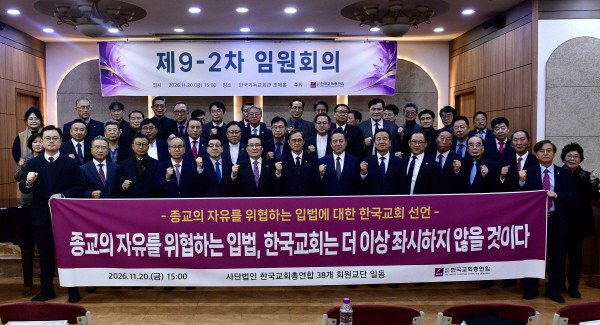 |
| Participants in an executive meeting of the United Christian Churches of Korea (UCCK) pose for a group photo holding banners opposing the Equality Act. The UCCK warned that churches nationwide would gather outside the National Assembly and in public squares if the government and the National Assembly ignored the demands of Korean churches. / Courtesy of the UCCK |
Thirty-eight Christian denominations in South Korea have united in opposition to the proposed Equality Act (Bill on Equality), introduced in the National Assembly amid serious concerns that it could undermine freedom of religion, conscience and expression.
The United Christian Churches of Korea (UCCK) announced on November 23 that it had adopted and issued the "Declaration of Korean Churches on Legislation Threatening Religious Freedom" at its seventh standing presidents' meeting and second executive meeting of its ninth term on November 20.
The declaration was jointly issued in the names of UCCK President Bishop Kim Jeong-seok, co-presidents Rev. Kim Dong-ki, Rev. Hong Sa-jin and Rev. Jung Jung-in, and the leaders of its 38 member denominations.
In the declaration, the UCCK expressed concerns over the Bill on Equality introduced by Rep. Park Joo-min as its lead sponsor on November 11, as well as proposed legislation to prevent collusion between religion and politics, proposed amendments to the Private School Act concerning the autonomy of Christian private schools, and the enforcement decrees of the Inheritance Tax and Gift Tax Act and the Corporate Tax Act affecting overseas missionary activities.
Regarding Park's Equality Bill in particular, the UCCK pointed out that although provisions for criminal penalties and punitive damages had been removed, the bill still included enforcement mechanisms such as corrective orders issued by the National Human Rights Commission of Korea (NHRCK), administrative fines for noncompliance and civil liability for damages. The UCCK made clear that merely modifying some penalty provisions would not resolve concerns over freedom of religion, conscience and expression.
While expressing respect for the value of equality, the UCCK stressed that constitutionally guaranteed religious freedom and church autonomy must also be respected in the pursuit of equality. It added, "We have consistently raised concerns about the relevant bills and enforcement decrees and urged the government and the National Assembly to take corrective action, but our concerns remain unresolved."
The UCCK set out three positions in the declaration. First, it called on the government and the National Assembly to immediately withdraw bills threatening freedom of religion, conscience and expression. It then pledged to mobilize the collective strength of its 38 member denominations and 65,000 churches nationwide and take action. It also warned that if the government and the National Assembly ignored the demands of Korean churches, churches across the country would gather outside the National Assembly and in public squares.
The legislative debate surrounding the Equality Act, also known as the comprehensive anti-discrimination law, which seeks to prohibit all forms of discrimination without reasonable grounds, including discrimination based on sex, disability, age and sexual orientation, has continued for 20 years. Discussions on comprehensive anti-discrimination legislation began in July 2006, when the NHRCK formally recommended that the government enact such a law. The main rationale behind the legislative initiative was that sector-specific laws, such as the Act on the Prohibition of Discrimination against Persons with Disabilities and the Equal Employment Opportunity Act, were insufficient to address intersecting forms of discrimination and gaps in human rights protection. Accordingly, in December 2007, under the Roh Moo-hyun administration, the Ministry of Justice introduced the first government-sponsored bill during the 17th National Assembly.
However, the legislative process faced fierce opposition from the outset. Initially, the business community expressed concerns that provisions prohibiting discrimination based on educational background and employment status would infringe upon companies' autonomy in recruitment. Opposition to provisions concerning sexual orientation and gender identity soon spread, particularly among Protestant churches and civic organizations. After the initial bill was discarded upon the expiration of the 17th National Assembly's term, similar bills were introduced during the 18th, 19th and 21st National Assemblies. Each failed to pass amid arguments that the legislation could undermine religious beliefs and freedom of expression, as well as political pressure on lawmakers. No such bill was introduced during the 20th National Assembly.
In an effort to ease social conflict, attempts to pass the legislation continued, with its name changed from the Anti-Discrimination Act to the Equality Act and its penalties reduced in severity. The Equality Bill introduced by Park as its lead sponsor emerged against this backdrop.
However, the divide between the two sides remains wide. Supporters argue that "legislation that has been delayed for 20 years must not be postponed any longer," while calling for revisions to address concerns that the removal of enhanced damages provisions could weaken the effectiveness of the bill. Opponents, meanwhile, as reflected in the UCCK's statement, maintain that even if penalty provisions are removed, the expression of critical views in religious sermons and educational settings will inevitably be inhibited as long as corrective orders, administrative fines for noncompliance and civil liability for damages remain in place.
The UCCK maintains a firm stance, viewing opposition to the enactment of anti-discrimination legislation as the last line of defense against what it regards as the harmful effects of political correctness (PC) seen in Europe.
In its latest statement, the UCCK declared, "Having sufficiently expressed the position of Korean churches, we will no longer confine ourselves to issuing statements and position papers but will take action alongside churches nationwide." It added, "It is now time for the government and the National Assembly to respond. Korean churches will respect the dignity of every individual and fulfill their responsibility to love their neighbors. However, we will not back down in defending religious freedom and church autonomy."
Hwang Ui-joong
Most Read
-
1
AMD's Lisa Su floated as potential Nvidia successo..

-
2
China President Xi's Keynote Speech at the APEC C..

-
3
Alice Huang, affair partner of Jensen Huang, repor..

-
4
Iran resumes attacks after two months, targeting U..

-
5
Russian warship sinks in suspected drone attack at..

-
6
Inside Kylin Villa, the symbol of China's reform h..

-
7
Trump, Xi, Putin call for security cooperation at..

PEOPLE






-
Address : In-Young Bldg., 34, Uisadang-daero 1-gil, Yeongdeungpo-gu, Seoul
Copyright by ASIATODAY CO., LTD. All rights resereved