



[Exclusive] Daishin, Mirae Asset Securities data breaches expose basic security failures
Nov 24, 2026, 09:07 am


 |
Amid data breaches affecting approximately 77,000 customers and employees at Daishin Securities and Mirae Asset Securities, Daishin Securities was found to have failed to filter out abnormal bulk data requests after its administrator credentials were stolen through malware.
Mirae Asset Securities was found to have had no verification procedure to ensure that users accessing account information were the actual account holders. It also fell victim to a conventional command manipulation attack that has been known for more than 20 years. These were all essential security checks that should have been carried out during IT system development and operation. The company was also found to have detected the breach only a day after the hacking attack.
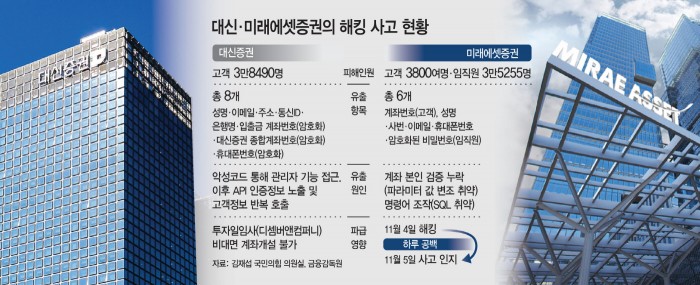
According to hacking incident reports submitted by Daishin Securities and Mirae Asset Securities to the Financial Supervisory Service (FSS) and obtained on November 23 by the office of Rep. Kim Jae-seop of the People Power Party, a member of the National Assembly's National Policy Committee, the Daishin Securities breach occurred on October 17 in a system within the demilitarized zone (DMZ), a buffer zone between external and internal networks.
According to the account of the attack detailed in the report, the hacker used malware to gain access to system administrator functions intended exclusively for users with the highest privileges. The hacker then stole application programming interface (API) credentials, which serve as access keys allowing external programs to connect to Daishin Securities' network. Using the stolen credentials, the hacker obtained valid access tokens and extracted 38,490 customer records by repeatedly requesting customer information.
The incident also disrupted business operations, including the suspension of online account opening services at its partner December & Company, a discretionary investment management firm. Daishin Securities detected the breach on the day of the incident, October 17, filed an initial report with financial regulators and shut down the compromised system.
At Mirae Asset Securities, both its customer-facing mobile website and its internal employee network (groupware) were compromised. The absence of account ownership verification on the mobile website allowed unauthorized access to approximately 3,800 account numbers through manipulation of request parameters sent to the server. The groupware system was vulnerable to SQL injection, a conventional hacking technique involving command manipulation to attack servers, resulting in the exposure of information on 35,255 employees.
Mirae Asset Securities also showed shortcomings in its initial security monitoring and reporting procedures. Although the company came under attack on November 4, it did not detect the breach until the following day. It did not report the incident to the FSS until November 6, two days after the attack.
Even when filing the report, the company listed the number of affected groupware users as "still being assessed," apart from the approximately 3,800 customers affected by the mobile website breach. Only after the incident did Mirae Asset Securities add user verification procedures to the affected services, block the IP addresses used in the attack and implement measures to prevent SQL injection. The company said it would address vulnerabilities through comprehensive penetration testing of externally accessible systems.
According to the final figures previously disclosed by the two companies through press releases and public notices, a total of 77,545 individuals were affected. The information leaked from Daishin Securities included customer names, email addresses, addresses, communications IDs and bank names, as well as encrypted deposit and withdrawal account numbers, Daishin Securities comprehensive account numbers and mobile phone numbers. At Mirae Asset Securities, the leaked information included customer account numbers and employee names, employee IDs, email addresses, mobile phone numbers and encrypted passwords.
"Controlling API credentials, blocking abnormal requests, and preventing parameter manipulation and SQL injection are all measures against hacking techniques that have been repeatedly used for years," an employee in the IT department of a securities firm said. "Major securities firms failed to follow basic security verification procedures, exposing the personal information of tens of thousands of people."
Meanwhile, personal information belonging to 8,241 Samsung Securities customers was also leaked. According to Samsung Securities, files attached by users to its Voice of Customer (VOC) message board were compromised on November 21, resulting in the exposure of up to 13 types of personal information, including names, account numbers and driver's license numbers.
Park I-sak
Most Read
-
1
AMD's Lisa Su floated as potential Nvidia successo..

-
2
China President Xi's Keynote Speech at the APEC C..

-
3
Alice Huang, affair partner of Jensen Huang, repor..

-
4
Iran resumes attacks after two months, targeting U..

-
5
Russian warship sinks in suspected drone attack at..

-
6
Inside Kylin Villa, the symbol of China's reform h..

-
7
Trump, Xi, Putin call for security cooperation at..

PEOPLE







-
Address : In-Young Bldg., 34, Uisadang-daero 1-gil, Yeongdeungpo-gu, Seoul
Copyright by ASIATODAY CO., LTD. All rights resereved