



One in six S. Korean Army video conferencing devices made in China
Oct 19, 2026, 05:41 pm


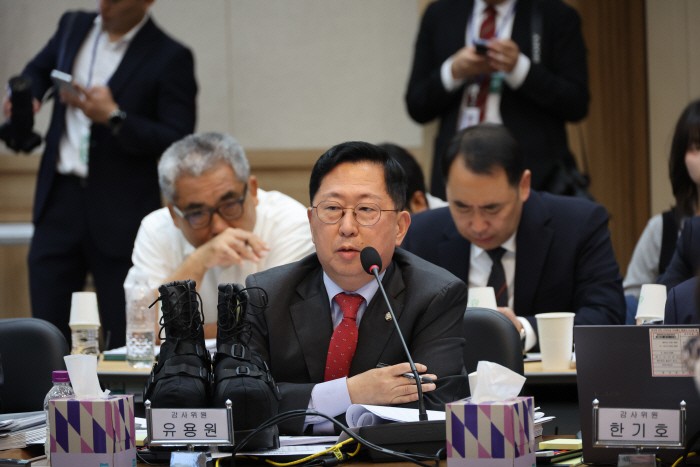 |
| Representative Yoo Yong-won places mine protection gear (mine-resistant boots and overshoes) on his desk while questioning during the National Assembly National Defense Committee's audit of the Army Headquarters and other military commands held at the Gyeryongdae military complex in Gyeryong, South Chungcheong Province, on the morning of the 19th. / Yonhap |
Concerns have been raised over potential leaks of military intelligence as the South Korean Army has installed and operated Chinese-made video conferencing equipment in corps- and division-level command and control centers as well as operational situation rooms.
According to data on the Status of Introduction and Operation of Chinese-Made Information and Communications Equipment submitted by the Army to Representative Yoo Yong-won of the People Power Party on the 19th, video conferencing codec products from Chinese telecommunications equipment maker Yealink accounted for 130 units, or roughly 16%, of the approximately 800 video conferencing units operated by the Army.
Of the 130 units, around 60 were installed in corps- and division-level command and control rooms, operations situation rooms, and intelligence operations rooms. Given that the equipment transmits and receives video and audio, Representative Yoo pointed out that sensitive military information could potentially leak externally if security vulnerabilities arise.
Representative Yoo explained, "Because corps- and division-level situation rooms are core facilities where various operational situations are shared in real time and commanders' orders are conveyed, they require stricter information protection and security management than general administrative facilities." He added, "The U.S. state government of Oklahoma banned the use of Yealink products—currently operated by our Army—on its state government network in 2024 due to security concerns."
In addition to video conferencing equipment, Chinese-made CCTV cameras possessed and operated by the South Korean military were also found to number around 1,770 units. According to Representative Yoo, the Army introduced approximately 510 Chinese-made CCTV cameras from 2022 to 2024, while the Navy operates 160 units, the Air Force 400 units, and the Marine Corps 700 units for perimeter surveillance operations and facility management.
Regarding this, the Army explained that because it operates the systems under multi-layered security measures, there are no security abnormalities. An Army official said, "We pursued projects to replace aging equipment in accordance with relevant laws and procedures, and the system is isolated on a separate dedicated network and operated under multi-layered security measures, including encryption equipment and cyber defense systems." The official added, "Although products from a Chinese manufacturer are included in some codecs among the introduced equipment, security inspections conducted by the Defense Counterintelligence Command and the Cyber Operations Command confirmed no unusual security issues."
The Army's video conferencing system is operated via a military-dedicated video teleconferencing (VTC) network isolated from external networks such as the internet, and because cybersecurity equipment including encryption devices, network access control, and unified threat management are applied along communications transmission segments, the military maintains there are no security vulnerabilities. The Army official explained, "The equipment in question is also operated across numerous domestic public institutions and state-owned enterprises."
Representative Yoo said, "The fact that a significant number of Chinese-made video conferencing devices that have raised security concerns overseas have been installed must not be taken lightly. Because even minor security vulnerabilities can lead to leaks of military intelligence, strict security management is necessary." He added, "Given that substantial numbers of Chinese-made CCTV cameras have also been introduced and operated across our military, the armed forces must closely inspect security management practices, centered on equipment installed in key facilities, and conduct thorough security verifications in future procurement processes."
Lee Han-sol
#China #Defense #Security #CCTV
Copyright by Asiatoday
Most Read
-
1
Celltrion nears additional contract with major U.S..

-
2
"Aren't those foreigners on welfare?": M..

-
3
U.S. weighs dropping MOAB, world's most powerful n..

-
4
Houthis launch successive attacks on Saudi airport..

-
5
Saudi Arabia, Iran hold first diplomatic talks to..

-
6
Saudi airport in Riyadh struck again, leaving at l..

-
7
Five ASEAN countries welcome Myanmar coup leader

PEOPLE






HEADLINE NEWS
- Trump's approval rating hits low of 33% as public turns back over soaring inflation
- Trump says Hyundai announced 748.6-billion-won investment in Georgia
- China tightens grip on boosting domestic demand and expanding anti-graft dr..
- Food prices jump 35% over 10 years, fueling massive protests by 800,000 acr..

-
Address : In-Young Bldg., 34, Uisadang-daero 1-gil, Yeongdeungpo-gu, Seoul
Copyright by ASIATODAY CO., LTD. All rights resereved