



‘Hwangja Hwatong’ found during mine search could rewrite history of gunpowder weapons
Sep 22, 2026, 09:58 am


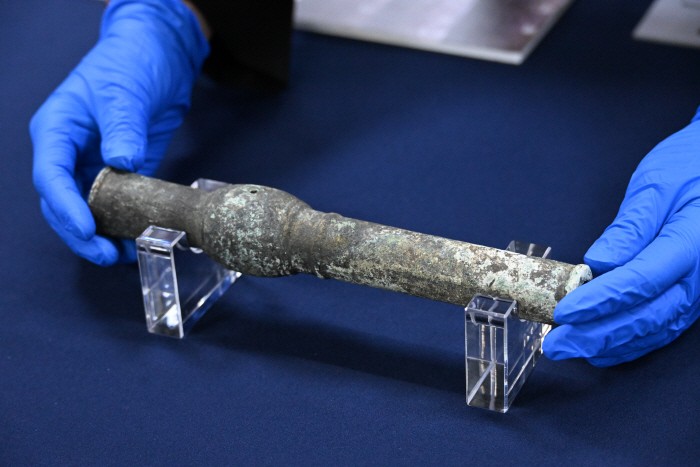 |
| The Hwangja Hwatong, Korea’s oldest known gunpowder weapon, is unveiled at the National Palace Museum of Korea in Jongno-gu, Seoul, on Sept. 21. / Courtesy of the Korea Heritage Service |
A small bronze firearm discovered during a landmine search has emerged as a major clue that could push back the known history of gunpowder weapons in Korea.
An inscription found on the weapon records not only when it was made, its name and weight, but also the names of the official who supervised its production and the craftsman who made it.
The Naju National Research Institute of Cultural Heritage under the National Research Institute of Cultural Heritage, part of the Korea Heritage Service, unveiled the results of its investigation into the Hwangja Hwatong discovered on Geumseongsan Mountain in Naju at a press briefing at the National Palace Museum of Korea in Jongno-gu, Seoul, on Sept. 21.
The institute conducted three years of scientific analysis and expert consultation after the artifact was discovered in 2023.
The Hwangja Hwatong is a small gunpowder weapon measuring 23.75 centimeters in length, with a bore diameter of 1.66 centimeters and a weight of 1,032 grams.
It was discovered by chance in November 2023 during a landmine detection operation ahead of construction work on a hiking trail on Geumseongsan Mountain.
A hwatong was a weapon that used gunpowder to fire arrows or projectiles. From the reign of King Sejong of the Joseon Dynasty onward, such weapons were generally referred to as chongtong.
The most notable feature is a 28-character inscription engraved on the body. Twenty-seven characters are inscribed on the socket where a handle would have been attached, while one character is engraved near the muzzle.
The inscription has been deciphered as: “丁巳十二月日 鍊 黃字火筒 重一斤十四兩 監造錄事安休甫 匠人石.”
It means: “In the 12th month of the Jeongsa year, the Hwangja Hwatong was made. It weighs one geun and 14 nyang. The supervising official was registrar An Hyu-bo, and the craftsman was Seok.”
The inscription therefore identifies not only the weapon’s name and weight, but also the government official who oversaw its production and the craftsman who actually made it.
The key question is determining exactly which “Jeongsa year” the inscription refers to.
Based on historical documents and the development of gunpowder weapons, researchers estimate that it was either 1377, the third year of King U of the Goryeo Dynasty, or 1437, the 19th year of King Sejong of the Joseon Dynasty.
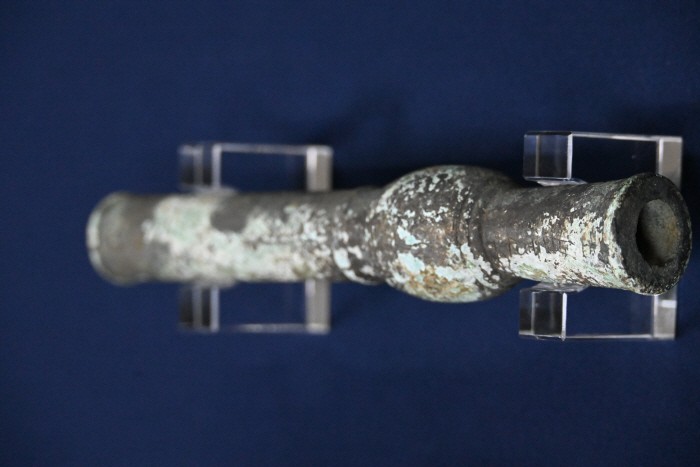 |
| The Hwangja Hwatong, Korea’s oldest known gunpowder weapon, is unveiled at the National Palace Museum of Korea in Jongno-gu, Seoul, on Sept. 21. / Courtesy of the Korea Heritage Service |
The year 1377 was when the government established the Hwatongdogam, or Firearms Directorate, at the suggestion of Choe Mu-seon, marking the start of state-led production of gunpowder weapons. The year 1437 also fell within a period of active firearms development under King Sejong.
For now, however, it is difficult to determine which of the two years the inscription refers to because few surviving gunpowder weapons from the late Goryeo to early Joseon periods are available for comparison.
The weapon’s form also supports the view that it dates from an early stage in the development of firearms.
CT and X-ray scans showed that the interior of the powder chamber is rounded, a feature of early firearms in which gunpowder and projectiles were loaded into a single chamber. Its structure differs from improved firearms introduced from the reign of King Sejong onward that used a wooden wad to separate the powder charge from the projectile.
The weapon was found to be made of bronze composed mainly of copper, tin and lead. Researchers also detected impurities left from traditional bronze casting, supporting the conclusion that it was made using manufacturing techniques of the period rather than in modern times.
Among existing gunpowder weapons with confirmed production dates, the earliest known example is the Cheonja Chongtong made in 1555.
If the Hwangja Hwatong was made in either 1377 or 1437, it would predate that weapon by well over a century.
Its academic value is also considered significant because its excavation site is clearly documented and key information about its production is preserved in the inscription.
The research institute said it plans to narrow down the production date through further study and conduct experiments to determine how the weapon was actually made and used.
The Hwangja Hwatong will be displayed to the public at the National Palace Museum of Korea from Sept. 23 through Nov. 22.
Jeon Hye-won
Most Read
-
1
Celltrion’s Omlyclo gains ground in major European..

-
2
Trump demands rates fall below 1% as Fed hikes for..

-
3
Trump makes $1 trillion bet ahead of midterm elect..

-
4
Iran resumes ballistic missile production, assembl..

-
5
Samsung Electronics, Mistral AI to jointly develop..

-
6
Trump warns countries not helping U.S. must pay re..

-
7
Apple launches first foldable, 1 million won prici..

PEOPLE






HEADLINE NEWS
- Trump to roll out ‘unprecedented welcome’ for Xi with B-2 bombers, F-22 fighters
- S. Korea, U.S., and Japan form united front on Taiwan and economic coercion..
- Trump administration moves to impose sweeping sanctions on International Cr..
- Xi to make state visit to U.S. Sept. 23-25, dispelling rumors over his heal..

-
Address : In-Young Bldg., 34, Uisadang-daero 1-gil, Yeongdeungpo-gu, Seoul
Copyright by ASIATODAY CO., LTD. All rights resereved