



Top 5 commercial banks poised to surpass 1,000 trillion won in time deposits
Aug 23, 2026, 10:23 am


 |
This image was generated by AI.
The balance of time deposits at South Korea's top five commercial banks is on the verge of surpassing 1,000 trillion won. As interest rates on time deposits climb into the 3 percent range while stock market investment fervor cools, the trend of a "reverse money move"—with market funds flowing back into banks—is becoming increasingly pronounced. With expansion in household loans restricted, banks are expected to deploy the secured liquidity into lending expansion, intensifying competition to secure blue-chip corporate clients.
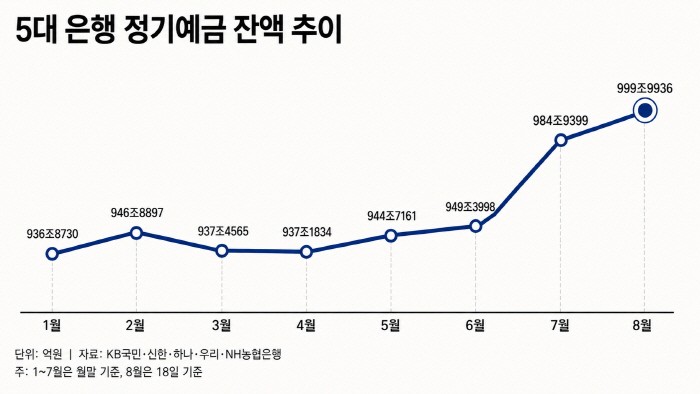
According to the financial sector on August 20, the combined balance of time deposits across the top five commercial banks (KB Kookmin, Shinhan, Hana, Woori, and NH NongHyup) stood at 999.9936 trillion won as of August 18. Compared to 984.9399 trillion won at the end of last month, this marks an increase of 15.0537 trillion won in just 18 days, leaving only 6.4 billion won shy of the 1,000 trillion won threshold. The banking industry views it as highly likely to breach the 1,000 trillion won mark within this month, given that the upward momentum persisted through the vacation season and holidays.
Funds flowing into time deposits have surged rapidly in recent months. The time deposit balance of the five major banks grew by 7.5327 trillion won in May and 4.6837 trillion won in June, followed by a sharp surge of 35.5401 trillion won in July alone.
Higher deposit rates have further fueled this influx of capital. According to disclosures by the Korea Federation of Banks, the highest interest rates for major one-year time deposits among the top five banks stand at an annual 3.20 to 3.30 percent. Shinhan Bank's "Shinhan My Plus Time Deposit" offers up to 3.30 percent annually, and NH NongHyup Bank's "NH All-One e-Deposit" offers 3.25 percent. Broadening the scope across the entire banking sector, SC First Bank's "e-Green Save Deposit" offers up to 3.85 percent annually including preferential rates, nearing 4 percent.
The key question is where the funds flowing into banks will be deployed going forward. With restrictions placed on household loan expansion, corporate lending is highly likely to emerge as the primary destination for managing the increased deposits.
Seo Ji-yong, a professor of business administration at Sangmyung University, projected, "With household loan expansion constrained, banks are likely to step up marketing for corporate loans, including middle-market and small-to-medium enterprises, to deploy their growing deposits. However, rather than simply expanding volume, competition over interest rates and credit limits is expected to center on prime enterprises equipped with creditworthiness, collateral capacity, and established transaction bases."
In fact, the balance of corporate loans at the five major banks reached 877.7085 trillion won at the end of July, an increase of 32.9831 trillion won compared to the end of last year. This is roughly triple the 11.3009 trillion won increase in household loans over the same period. In July alone, corporate loans rose by 4.6239 trillion won.
However, intensifying lending competition over funds raised at high interest rates could also increase the burden of profitability management. Professor Seo noted, "If interest rate competition in corporate lending intensifies while the volume of high-rate time deposits increases, funding costs will remain elevated while asset management returns decline, potentially squeezing the loan-to-deposit margin. Rather than pursuing reckless lending expansion, banks must pay closer attention to managing risk-adjusted return on lending while simultaneously controlling maturity structures and liquidity."
Park Seo-ah |
Most Read
-
1
Celltrion nears additional contract with major U.S..

-
2
Putin proposes trilateral U.S.-China-Russia summit..

-
3
U.S. weighs dropping MOAB, world's most powerful n..

-
4
"Aren't those foreigners on welfare?": M..

-
5
Attention centers on APEC for possible Trump-Xi-Pu..

-
6
Saudi Arabia, Iran hold first diplomatic talks to..

-
7
Saudi airport in Riyadh struck again, leaving at l..

PEOPLE







-
Address : In-Young Bldg., 34, Uisadang-daero 1-gil, Yeongdeungpo-gu, Seoul
Copyright by ASIATODAY CO., LTD. All rights resereved