



Private bankers advise "buy dollars gradually" as Won falls into 1,300s
Aug 23, 2026, 10:07 am


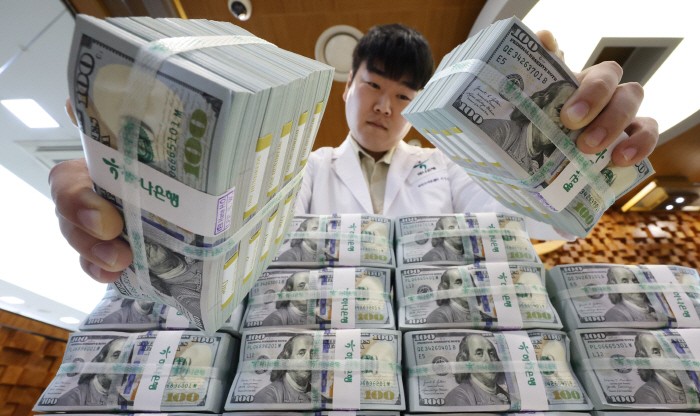 |
| An employee organizes foreign currency at Hana Bank's Counterfeit Response Center in Jung-gu, Seoul. / Yonhap |
With the won-dollar exchange rate falling into the 1,300-won range in less than two months after sitting in the 1,500-won range, demand to buy dollars cheaply is rising. As the rate has dropped significantly from its peak, banks are seeing an increase in dollar deposit balances, signaling growing bargain-hunting activity.
Still, since further declines remain possible, bank private bankers recommend a "dollar-cost averaging" approach — spreading out purchases over time rather than buying all at once. For investors who bought dollars when the rate was high, bankers recommend holding onto their dollars and preparing for a potential rebound rather than rushing to convert back to won.
According to the financial industry on the 21st, the won-dollar exchange rate closed that day at 1,386.5 won, down 6.1 won from the previous session. Having climbed as high as 1,559.2 won on July 1, the rate has fallen more than 170 won in less than two months — a rapid strengthening of the won driven by a combination of dollar weakness and dollar-selling by exporters.
As the exchange rate has fallen, demand to secure dollars in advance has also grown. Dollar deposit balances at the four major banks (KB Kookmin, Shinhan, Hana, and Woori) rose from $58.2 billion at the end of June to $62 billion at the end of July — an increase of $3.8 billion (6.6%) in a single month. The trend has continued into August. This is seen as reflecting demand to secure dollars at lower prices amid the rate's sharp, short-term decline.
Bank private bankers advise that rather than buying dollars all at once, investors should spread out both the timing and amount of their purchases. One commercial bank private banker said, "We believe the recent decline in the exchange rate reflects temporary factors, such as the won moving in tandem with the yen to help stabilize long-term U.S. Treasury yields, and currency conversion tied to SK Hynix's American Depositary Receipts (ADRs)," adding, "Since exchange rates are inherently hard to predict, we recommend buying gradually as a hedging strategy rather than waiting for a specific price."
Experts project the exchange rate could rebound in the short term but expect the broader downward trend to continue for some time. Min Kyung-won, a researcher at Woori Bank, said, "The rate has been falling quickly recently, so it could rebound to around 1,400 won in the short term, but we expect the broader trend to continue declining into early next year," adding that he sees room for the rate to fall as low as 1,350 won. He added, "From around 1,370 won, demand to buy dollars for overseas investment and other purposes could start flowing in, which may limit further declines."
For investors who bought dollars while the rate was high, rather than immediately converting back to won now that the rate has fallen, there's also the option of holding onto their dollars and earning interest income in the meantime. Dollar deposits offer the advantage of stability and liquidity, and investors can also seek returns by parking dollars in foreign-currency repurchase agreements (RPs) or dollar money market funds (MMFs). A financial industry official said, "It's a good idea to invest in short-term dollar products like dollar deposits, dollar RPs, or foreign-currency-denominated promissory notes, earning interest income while watching how the exchange rate moves."
Lee Bo-ra
Most Read
-
1
Celltrion nears additional contract with major U.S..

-
2
Putin proposes trilateral U.S.-China-Russia summit..

-
3
U.S. weighs dropping MOAB, world's most powerful n..

-
4
"Aren't those foreigners on welfare?": M..

-
5
Attention centers on APEC for possible Trump-Xi-Pu..

-
6
Saudi Arabia, Iran hold first diplomatic talks to..

-
7
China tightens grip on boosting domestic demand an..

PEOPLE







-
Address : In-Young Bldg., 34, Uisadang-daero 1-gil, Yeongdeungpo-gu, Seoul
Copyright by ASIATODAY CO., LTD. All rights resereved