



Government freezes petroleum price cap for 9th consecutive round
Aug 23, 2026, 09:57 am


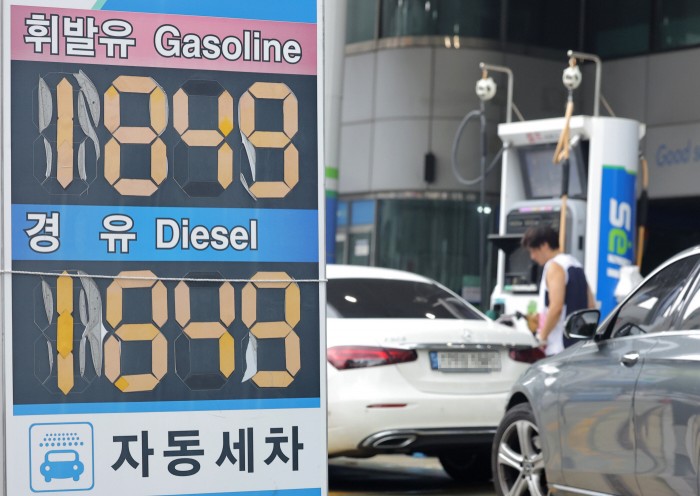 |
| A citizen fills up their car at a gas station in Seoul on the 21st, as domestic producer prices fell for the first time in 11 months last month. / Yonhap |
The Ministry of Trade, Industry and Energy is holding the ninth round of petroleum price caps at existing levels, even as international oil prices climb again amid unrest in the Middle East.
The ministry announced on the 21st that it will maintain the ninth-round price caps, effective for four weeks starting midnight on the 22nd, at the same levels as the eighth round.
Under this, price caps will remain at 1,784 won per liter for gasoline, 1,773 won for diesel, and 1,380 won for kerosene.
International oil prices have recently trended upward again as ceasefire negotiations between the U.S. and Iran have stalled. Uncertainty in the Middle East has grown as the two countries' standoff has continued even after the 60-day term of the U.S.-Iran ceasefire memorandum of understanding, signed in June, expired.
By international benchmark, Brent crude fell from $88.5 per barrel on the 5th of last month to $81.7 on the 1st of this month, before climbing back to $93.8 by August 20. Dubai crude similarly rose from $80.9 to $95.6 over the same period.
International petroleum product prices also rose. International gasoline prices fell from $116 per barrel on the 5th of last month to $105 on the 1st of this month, before recovering to $114 by the 20th. Diesel similarly fell from $159 to $148 over the same period before rising to $164.
While closely monitoring the possibility of further increases in international oil prices, the government decided to freeze the price cap this round, taking into account the burden on lower-income consumers. It also considered that current international oil and petroleum product prices are not significantly different from when the eighth-round cap was set, and that abnormal weather such as the heat wave and heavy rain has been adding to the burden on people's livelihoods.
Current domestic gas station prices remain higher than the price cap. Domestic gasoline prices have continued declining since the seventh-round cap took effect on June 27, reaching 1,862 won per liter as of August 20. Diesel stood at 1,845 won.
Going forward, the government plans to monitor Middle East conditions and international oil price fluctuations in real time, and to flexibly operate the price cap system by comprehensively weighing petroleum supply and demand, prices, the burden on people's livelihoods, and the need for demand management.
Kim Jeong-kyu
Most Read
-
1
Celltrion nears additional contract with major U.S..

-
2
Putin proposes trilateral U.S.-China-Russia summit..

-
3
U.S. weighs dropping MOAB, world's most powerful n..

-
4
"Aren't those foreigners on welfare?": M..

-
5
Attention centers on APEC for possible Trump-Xi-Pu..

-
6
Saudi Arabia, Iran hold first diplomatic talks to..

-
7
China tightens grip on boosting domestic demand an..

PEOPLE







-
Address : In-Young Bldg., 34, Uisadang-daero 1-gil, Yeongdeungpo-gu, Seoul
Copyright by ASIATODAY CO., LTD. All rights resereved