



N. Korea strongly pushes back despite Trump's directive to scale down UFS drills
Aug 20, 2026, 09:26 am


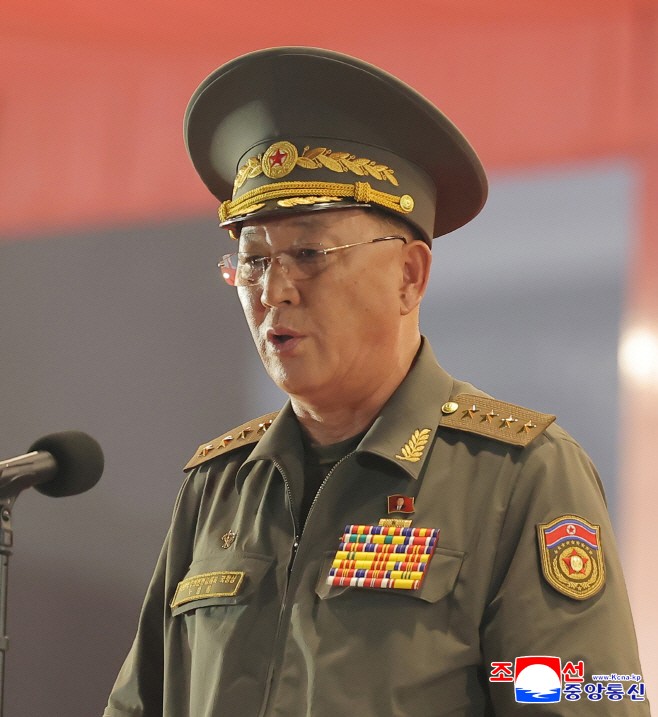 |
| North Korean leader Kim Jong-un attended a parade ceremony in Pyongyang on July 27 to mark the 73rd anniversary of the signing of the Korean War armistice (Victory Day), the Korean Central News Agency reported on July 28. The photo shows Defense Minister No Kwang-chol delivering a speech. / Yonhap News |
North Korea on August 19 issued a fierce threat regarding the ongoing Ulchi Freedom Shield (UFS) exercise, stating that "adversaries will constantly remain within the precise crosshairs of annihilating retaliatory means." This strong pushback came despite U.S. President Donald Trump's directive to significantly scale down the UFS drills.
Analysts suggest North Korea is seeking to use President Trump's "love call" to leader Kim Jong-un—alongside his complaints about training costs and frustration with South Korea—as leverage to push for a complete halt to South Korea-U.S. joint exercises.
In a commentary released ahead of the South Korean military authorities' official announcement on the UFS cutbacks, the Korean Central News Agency (KCNA) referred to the exercise in detail, asserting, "Our exercise of the right to self-defense to thoroughly neutralize the enemies' military threats will be manifested in even more explicit actions. Threatening moves require a response with evolved, new strength."
The state media particularly cited remarks made earlier this month by Scott Winter, deputy commander of the United Nations Command (UNC), regarding UNC cooperation for South Korea's defense. The commentary claimed that he "treated the actual deployment of the largest-ever multinational aggression force under the guise of the UN Command in a Korean Peninsula contingency as a foregone conclusion." By asserting that the UNC is virtually part of the U.S. military, North Korea reiterated its wariness over the revival of the command's combat functions and expanded role. Notably, the commentary contained no direct mention of President Trump's directive to reduce UFS or criticism aimed at him.
Experts analyze that Pyongyang intends to capitalize on President Trump's critical stance toward joint exercises to demand the total abolition and suspension of combined drills and a curtailed role for the UNC.
Park Won-gon, a professor at Ewha Womans University, observed, "While President Trump ordered training cutbacks, North Korea expressed a routine objection given that UFS is underway regardless," adding, "At the same time, it carries the message demanding an end to all forms of military exercises."
Furthermore, North Korea's focus on the UNC's expanded role is noteworthy. By arguing that the threat of UNC multinational forces is materializing alongside the South Korea-U.S. alliance, Pyongyang appears to be building justification for building up and modernizing its nuclear and conventional forces. In particular, the mention of responding with "evolved, new strength" points to potential new forms of military provocations. Some observers also suggest Pyongyang intends to escalate regional tensions to secure the upper hand in anticipated future talks with Washington.
Given that the commentary was issued under the name of the state news agency—a lower-tier format compared to statements by Kim Yo-jong, director of the General Affairs Department, or the foreign and defense ministries—some view it as a standard response to joint drills. Consequently, high-level North Korean statements may follow regarding President Trump's overtures to Kim Jong-un or President Lee Jae-myung's proposal for a multilateral consultative body aimed at ending the war.
Professor Park projected, "If there is an official invitation or proposal for dialogue from the U.S. administration, or contact via a personal letter from President Trump, North Korea may then issue a formal response adhering to protocol," noting, "Until then, it will likely maintain a wait-and-see posture."
Mok Yong-jae
Most Read
-
1
Alteogen secures European patent for Keytruda SC,..

-
2
Trump shares map on social media labeling Strait o..

-
3
Celltrion seeks rheumatoid arthritis indication ex..

-
4
Kia Sportage outperforms Mazda CX-5 in German auto..

-
5
Chinese e-commerce giants AliExpress, Temu and She..

-
6
China expels No. 2 military official Zhang Youxia..

-
7
U.S. deploys carrier, 10,000 more troops to Middle..

PEOPLE






-
Address : In-Young Bldg., 34, Uisadang-daero 1-gil, Yeongdeungpo-gu, Seoul
Copyright by ASIATODAY CO., LTD. All rights resereved