



S. Korea-U.S. exercises halved, cumulative cutbacks could impact combined defense and OPCON transfer
Aug 20, 2026, 09:23 am


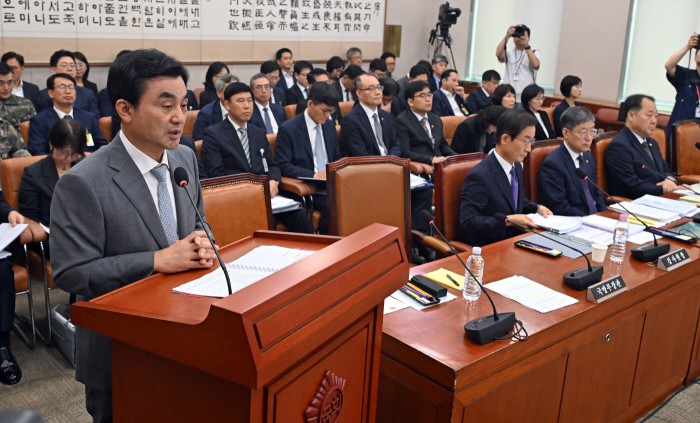 |
| Defense Minister Ahn Gyu-back delivers a work report during a plenary meeting of the Legislation and Judiciary Committee at the National Assembly on August 19. / Song Eui-ju |
South Korea and U.S. military authorities decided on August 19 to end the ongoing Ulchi Freedom Shield (UFS) exercise on August 21—six days earlier than originally scheduled—and scale down some combined field training maneuvers. The move comes in response to U.S. President Donald Trump's directive to significantly reduce the scope of the exercise. Concerns are emerging that this could considerably impact combined defense readiness and the validation timeline for the transition of wartime operational control (OPCON), core pillars of the South Korea-U.S. alliance.
The Joint Chiefs of Staff announced that day that South Korea and the U.S. agreed to adjust the duration and scale of the UFS exercise. Originally scheduled to run for 11 days from August 17 to 27, the exercise will now end on August 21, cutting the duration to five days. Some combined field training exercises will also be reduced. The two allies maintain that they will continue necessary measures to achieve training objectives and establish combined defense readiness.
Due to this adjustment, conducting the second half of the UFS exercise has become difficult. UFS comprises a first part focused on defensive operations and a second part mastering counterattack operations. With the second half—originally set for August 24–27—scrapped, the overall scale of the exercise has effectively been cut in half. Live-maneuver drills are also expected to be partly scaled back or converted into simulations.
The decision was made immediately following President Trump's sudden directive to downsize the exercise. On August 16, just before UFS began, President Trump instructed the U.S. Department of Defense to reduce the drills by a "significant degree," citing training costs and his "good relationship" with North Korean leader Kim Jong-un. The U.S. side maintains that core readiness and training objectives will be preserved despite the adjustment.
However, inside and outside military circles, concerns are being raised that the fallout could extend far beyond a simple shortening of the exercise period. UFS serves as a core drill to test the combined South Korea-U.S. command structure in contingencies and validate operational capabilities. Command post exercises and field maneuvers are vital means for regularly rotating South Korean and U.S. commanders and staff officers to master practical operational procedures; accumulated cutbacks could therefore undermine combined readiness.
The shift could also pose a variable for the preparations regarding the transfer of wartime operational control (OPCON). UFS has served as a primary platform to evaluate the operational capabilities of the Future Combined Forces Command led by the South Korean military. Analysts point out that omitting counterattack operations and live maneuvers could diminish opportunities to sufficiently validate South Korea's capability to lead combined operations. Experts are likewise raising the possibility that the cutbacks could affect preparations for the OPCON transition.
Controversy also appears inevitable over the balance between President Trump's cost-cutting rationale and the actual security toll. While detailed training costs are not disclosed, military experts point out that evaluating combined drills solely in monetary terms is flawed, as they serve as an iterative process to validate the deployment of U.S. reinforcement forces and the operation of command systems in contingencies, going well beyond simple troop movements.
Although South Korea and U.S. military authorities maintain that core readiness remains sound, with the 11-day schedule slashed to five days and some live-maneuver drills curtailed, how these changes affect combined defense posture and OPCON transition preparations is set to become a new test for the alliance.
Gu Pil-hyeon
Most Read
-
1
Alteogen secures European patent for Keytruda SC,..

-
2
Trump shares map on social media labeling Strait o..

-
3
Celltrion seeks rheumatoid arthritis indication ex..

-
4
Kia Sportage outperforms Mazda CX-5 in German auto..

-
5
Chinese e-commerce giants AliExpress, Temu and She..

-
6
China expels No. 2 military official Zhang Youxia..

-
7
U.S. deploys carrier, 10,000 more troops to Middle..

PEOPLE







-
Address : In-Young Bldg., 34, Uisadang-daero 1-gil, Yeongdeungpo-gu, Seoul
Copyright by ASIATODAY CO., LTD. All rights resereved