



S. Korea cautious yet hopeful amid signals of U.S.-North Korea dialogue
Aug 19, 2026, 09:10 am


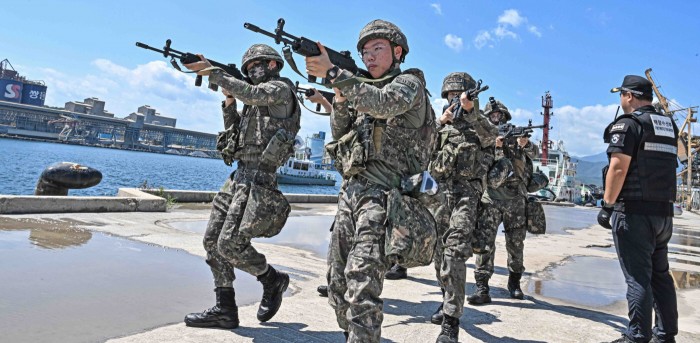 |
| The ROK Navy's 1st Fleet Command conducts a joint port defense drill involving government, military, and police forces at Donghae Port, Gangwon Province on the 18th, as part of the "2026 Ulchi Freedom Shield (UFS) exercise." / Yonhap |
Attention is turning to whether U.S.-North Korea dialogue will actually materialize, after President Donald Trump said North Korean leader Kim Jong-un had responded to his "love call." With President Lee Jae-myung's proposal for "multilateral discussions to end the war" in his August 15 Liberation Day address, followed by Trump signaling a reduction in Korea-U.S. joint military exercises, conditions appear to be forming for dialogue that could shift the trajectory of the Korean Peninsula situation. The government is closely watching whether North Korea responds, while weighing how to build momentum from U.S.-North Korea talks into improved inter-Korean relations and eventually four-party consultations involving South and North Korea, the U.S., and China.
A Ministry of Unification official told reporters on the 18th, "If U.S.-North Korea talks take place, we believe it would help shift the atmosphere toward inter-Korean reconciliation, and we will play the role of a pacemaker," adding, "In our second-half briefing to the president, we outlined a plan to begin discussions on converting the armistice into a peace regime through U.S.-North Korea talks, then move toward four-party talks — and we believe the current situation aligns with that trajectory."
Earlier this month, the Unification Ministry outlined plans in its presidential briefing to support a U.S.-North Korea summit and pursue a four-party peace declaration. Unification Minister Chung Dong-young has also proposed expanding contact with North Korea around the UN General Assembly in September and the APEC summit in Shenzhen, China in November. Plans to participate in the 11th Eastern Economic Forum in Vladivostok, Russia in early September and to activate peace envoys for the Korean Peninsula fit within this same approach.
The ministry expects that the current convergence of President Lee's August 15 proposal and Trump's messaging toward North Korea will serve as an opportunity to flesh out the government's second-half North Korea strategy. The official said, "As a pacemaker, it's important to develop various initiatives going forward," adding, "We will work this out through consultation with relevant agencies."
Still, some caution that it remains to be seen whether this will actually lead to U.S.-North Korea talks, given uncertainty over whether Trump's remarks reflect careful deliberation within the U.S. government, and the fact that North Korea has yet to officially respond to either President Lee's proposal for talks to end the war or the move to scale back joint exercises.
Even if a summit between the U.S. and North Korea were to happen suddenly, there are no shortage of pessimistic views on whether it would lead to substantive results. Since North Korea has completed internal legal and institutional measures to cement its status as a nuclear state and continues to advance its nuclear arsenal, while the U.S. maintains its denuclearization principle, the two sides sitting down "without common ground" could simply reaffirm their differences. This is why some project that even if a summit takes place, it could amount to little more than a "show" meeting aimed at domestic political needs.
Shin Beom-chul, a senior research fellow at the Sejong Institute, said the fact that North Korean denuclearization consistently appears in messaging from Korea-U.S. and Japan-U.S. summits shows the U.S. administration has not abandoned denuclearization, adding that because the moment the U.S. recognizes North Korea's nuclear status it would lose leverage on non-proliferation issues, Trump's "love call" is likely focused on managing risk from North Korea rather than genuine engagement.
Mok Yong-jae
Most Read
-
1
Trump shares map on social media labeling Strait o..

-
2
Kia Sportage outperforms Mazda CX-5 in German auto..

-
3
U.S. deploys carrier, 10,000 more troops to Middle..

-
4
Trump rejects Iran's offer to open Strait of Hormu..

-
5
N. Korea conducts first swarm attack drill with dr..

-
6
U.S.-China summit falls short on substance as Trum..

-
7
Japan tracks Ukraine fiber-optic drones, bolsters..

PEOPLE






HEADLINE NEWS
- Pyongyang calls DMZ explosion Seoul's fabrication and grave provocation
- U.S. Department of Defense completely halts use of blacklisted Anthropic AI
- 2026 Nobel Prize in Physics awarded to Francis Halzen for neutrino research
- French students take to streets, expressing frustration over economy, educa..

-
Address : In-Young Bldg., 34, Uisadang-daero 1-gil, Yeongdeungpo-gu, Seoul
Copyright by ASIATODAY CO., LTD. All rights resereved