



Galaxy sells out in Japan
Aug 11, 2026, 09:05 am


 |
Samsung Electronics' standing is shifting in Japan, a market long regarded as a "graveyard for foreign phones" and an emerging market for foldables. Following strong local demand for the flagship bar-type Galaxy S series, the foldable Galaxy Z series is now driving meaningful sales results as well. Industry observers credit much of this to the leadership of DX Division Head Roh Tae-moon (President), who has strengthened ties with local distribution channels and partners through hands-on management, beyond simply improving product quality. Building on this string of successes, Samsung's Japan smartphone strategy could see a faster reshaping going forward.
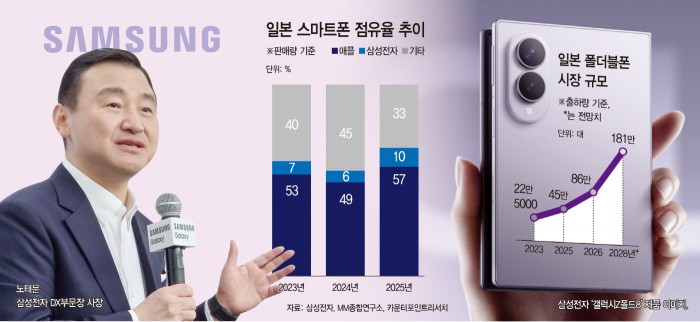
According to Samsung Electronics on the 10th, the recently launched Galaxy Z Fold8 has largely sold out in its 256GB configuration on Japan's official online store. With initial orders concentrated early on, sequential shipping isn't expected until later this month. Sales have also been strong at major local carriers including NTT Docomo, SoftBank, and Rakuten Mobile, where some models have similarly sold out and are now available for pre-order only.
In Japan's smartphone market, most brands hold only single-digit market share, with Apple alone accounting for more than half. Samsung Electronics, the world's top smartphone maker by shipment volume, has struggled to gain traction in Japan in recent years, also holding a single-digit share. According to market research firm Counterpoint Research, Samsung's share of Japan's smartphone market stood at 10% last year.
While that still trails far behind market leader Apple (57%) over the same period, it drew attention for marking Samsung's return to double-digit share for the first time in three years, since 2022 (10.5%). A survey by Japan's MM Research Institute (MMRI) also found Samsung ranked third in shipments for both mobile phones (including feature phones) and smartphones last year — the first time the company has placed in the top three in both categories since 2020.
Roh Tae-moon has played a major role in driving Samsung's growing smartphone demand in Japan, including the success of the Galaxy Z8 series. Sources inside and outside the company credit the close partnerships he has personally cultivated with local distribution channels as a powerful driver of this momentum. Roh visited Japan in June and met with local carriers including NTT Docomo and KDDI. At those meetings, he reportedly thanked the carriers for the strong performance of the Galaxy S26 series launched earlier this year and discussed sales cooperation for the Galaxy Z8 series. Roh also visited Japan in April to review the smartphone business and discuss cooperation plans with SoftBank and others.
Samsung Electronics officially resumed smartphone sales through SoftBank in February of last year — its first distribution partnership with the carrier in about a decade, since the Galaxy S6 was sold there in 2015. Through this, Samsung has now secured distribution through all four major Japanese carriers: NTT Docomo, KDDI, SoftBank, and Rakuten Mobile. Given the local market's particular emphasis on carrier-sold devices, Samsung is currently pursuing synergy by linking its official online store in Japan with carrier sales channels.
Attention is also turning to whether Samsung's Japan smartphone strategy could shift further. Industry observers say the company could adopt a more aggressive approach as demand grows, which is part of why there is speculation Samsung could preemptively introduce new form factors like a tri-fold device in Japan. Choi Won-joon, Chief Operating Officer of Samsung's MX Business, indeed mentioned in a March interview with a local outlet that the company is considering launching a tri-fold device.
At the time, Choi said of Japan's foldable market that the foundation is now in place for it to move toward becoming mainstream, adding that Samsung would carefully monitor customer response and market conditions before deciding.
An industry official said the long-cultivated, hands-on relationships with distribution partners have proven key to breaking open Japan's conservative smartphone market, adding that depending on how much market share Samsung gains going forward, Japan could well become an active candidate site for future Galaxy Unpacked events.
Yeon Chan-mo
Most Read
-
1
Trump shares map on social media labeling Strait o..

-
2
Kia Sportage outperforms Mazda CX-5 in German auto..

-
3
Houthis launch successive attacks on Saudi airport..

-
4
U.S. deploys carrier, 10,000 more troops to Middle..

-
5
Trump rejects Iran's offer to open Strait of Hormu..

-
6
N. Korea conducts first swarm attack drill with dr..

-
7
U.S.-China summit falls short on substance as Trum..

PEOPLE






HEADLINE NEWS
- Seoul dismisses Ukraine's claim of 'S. Korean support for Russia' as "inaccurate and inappropriate"
- S. Korea, Japan race to develop nuclear-powered submarines
- Henri Kagan, Kenso Soai win Nobel Prize in Chemistry for uncovering how mol..
- Vance says Alaska LNG cooperation will move forward with Seoul's current or..

-
Address : In-Young Bldg., 34, Uisadang-daero 1-gil, Yeongdeungpo-gu, Seoul
Copyright by ASIATODAY CO., LTD. All rights resereved