



S. Korea targets mid-2030s launch of first nuclear-powered submarine
Aug 05, 2026, 09:29 am


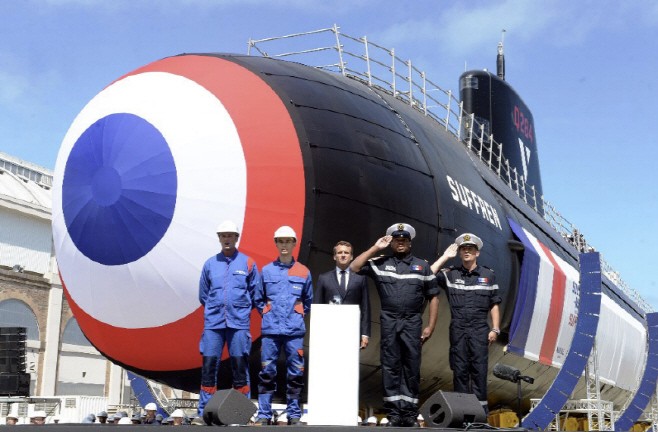 |
| Launch of the next-generation nuclear-powered attack submarine (SSN) "Suffren" in Cherbourg, France, in July 2019. French President Emmanuel Macron (center) and crew members pose in front of the 5,300-ton hull, decorated with the French tricolor. The Suffren is the lead vessel of France's Barracuda-class, powered by a small modular reactor (SMR) using low-enriched uranium (LEU) below 20% enrichment. It is regarded as a key benchmark model for South Korea's planned nuclear-powered submarine, the "Jang Bogo-N." As a vessel capable of 24-hour covert operations while complying with international non-proliferation norms through its LEU-based SMR technology, it stands as a symbolic reference point for the kind of capability envisioned as central to a "kill chain" strategy aimed at detecting and neutralizing enemy submarine-launched ballistic missiles (SLBMs) in advance. / Courtesy of Office of the President of France |
The underwater security landscape on the Korean Peninsula is shifting as both South and North Korea push forward with plans to build nuclear-powered submarines (SSNs). The Financial Times noted on the 28th of last month (local time) that this North-South nuclear submarine rivalry, intertwined with the U.S.-China contest for maritime dominance, could reshape the security landscape of Northeast Asia itself.
The situation pits South Korea's "Jang Bogo-N" project — advanced on the back of what amounts to tacit U.S. approval — directly against North Korea's plan for an 8,700-ton nuclear submarine, which seeks a technological leap by leveraging closer ties with Russia.
Defense Minister Ahn Gyu-baek, who unveiled the Jang Bogo-N program on May 26, said, "We will pursue the program with the goal of launching the first vessel in the mid-2030s." The reactor will run on low-enriched uranium (LEU) with enrichment below 20%, and both the hull and reactor are to be built and developed domestically.
The submarine's displacement, initially considered at around 5,000 tons, is understood to have been sharply increased to 7,000-8,000 tons after North Korea unveiled its 8,700-ton SSBN — a scale comparable to the U.S. Navy's Virginia-class attack submarines (about 7,800 tons), its primary nuclear attack submarine.
Given the Navy's current fleet of the Dosan Ahn Chang-ho (3,000 tons) and Jang Yeong-sil (3,600 tons), expanding shipyard construction infrastructure and building new radiation shielding facilities will be necessary tasks. The choice of LEU follows the low-enrichment route adopted by France's Barracuda (Suffren)-class submarines, in contrast to the highly enriched uranium (HEU) approach used by the U.S. Navy and the UK.
Moon Keun-sik, a professor at Hanyang University, told the FT that while North Korea has shown the submarine's exterior, whether the reactor and the core technology connecting it actually function needs to be verified. Reactor miniaturization and sealing technology, along with underwater acoustic stealth (noise reduction), are seen as the biggest variables for actual combat deployment, with observers noting that failing to reduce vibration and noise beyond levels typical of diesel submarines could become a fatal weakness, leaving the vessel vulnerable to early detection by anti-submarine surveillance networks.
The underwater arms race in Northeast Asia has already moved beyond the conceptual stage into actual force deployment. Just as North Korea's 8,700-ton submarine faces the variable of verified combat readiness, South Korea's Jang Bogo-N must also clear diplomatic hurdles, including revising the Korea-U.S. atomic energy agreement and securing a stable supply of LEU fuel. Maritime security experts in the Indo-Pacific region say the success of Jang Bogo-N will ultimately depend as much on skillful negotiation with the U.S. as on technological capability.
Koo Pil-hyun
Most Read
-
1
Trump shares map on social media labeling Strait o..

-
2
Kia Sportage outperforms Mazda CX-5 in German auto..

-
3
Houthis launch successive attacks on Saudi airport..

-
4
U.S. deploys carrier, 10,000 more troops to Middle..

-
5
Trump rejects Iran's offer to open Strait of Hormu..

-
6
N. Korea conducts first swarm attack drill with dr..

-
7
U.S.-China summit falls short on substance as Trum..

PEOPLE






HEADLINE NEWS
- Seoul dismisses Ukraine's claim of 'S. Korean support for Russia' as "inaccurate and inappropriate"
- S. Korea, Japan race to develop nuclear-powered submarines
- Henri Kagan, Kenso Soai win Nobel Prize in Chemistry for uncovering how mol..
- Vance says Alaska LNG cooperation will move forward with Seoul's current or..

-
Address : In-Young Bldg., 34, Uisadang-daero 1-gil, Yeongdeungpo-gu, Seoul
Copyright by ASIATODAY CO., LTD. All rights resereved