



Military urges caution over landmines swept down by torrential rains during monsoon season
Jul 07, 2026, 10:16 am


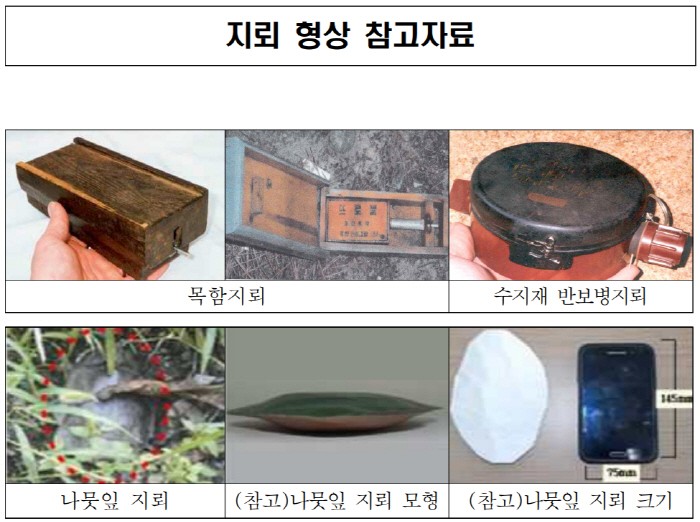 |
| Landmine identification reference image. / Courtesy of the Joint Chiefs of Staff |
The military urged caution on July 7 regarding the potential influx of landmines swept away by torrential rains in regions along the inter-Korean border ahead of the summer monsoon season.
The Joint Chiefs of Staff (JCS) announced on the same day, "We advise vigilance as there are concerns that displaced landmines may drift in through rivers in the event of heavy downpours throughout the border areas."
A large volume of North Korean landmines are buried within the Demilitarized Zone (DMZ). Portions of these minefields are connected to shared inter-Korean waterways—such as the Imjin, Hantan, Hwa, North Han, and Inbuk rivers—which flow into the Han River estuary. The JCS explained that during heavy downpours, buried mines risk getting dislodged and washed down into South Korean territory.
"We advise the public to look out for displaced landmines when engaging in activities near shared inter-Korean waterways," a JCS official stated. "If you discover an unidentified object suspected to be a landmine in these areas, do not touch it under any circumstances and report it immediately to the nearest military unit or police station."
Lee Han-sol
Most Read
-
1
Trump shares map on social media labeling Strait o..

-
2
Kia Sportage outperforms Mazda CX-5 in German auto..

-
3
Houthis launch successive attacks on Saudi airport..

-
4
U.S. deploys carrier, 10,000 more troops to Middle..

-
5
Trump rejects Iran's offer to open Strait of Hormu..

-
6
N. Korea conducts first swarm attack drill with dr..

-
7
U.S.-China summit falls short on substance as Trum..

PEOPLE






HEADLINE NEWS
- Seoul dismisses Ukraine's claim of 'S. Korean support for Russia' as "inaccurate and inappropriate"
- S. Korea, Japan race to develop nuclear-powered submarines
- Henri Kagan, Kenso Soai win Nobel Prize in Chemistry for uncovering how mol..
- Vance says Alaska LNG cooperation will move forward with Seoul's current or..

-
Address : In-Young Bldg., 34, Uisadang-daero 1-gil, Yeongdeungpo-gu, Seoul
Copyright by ASIATODAY CO., LTD. All rights resereved