



Lee Sang-min gets 7 years for insurrection
Feb 13, 2026, 07:58 am


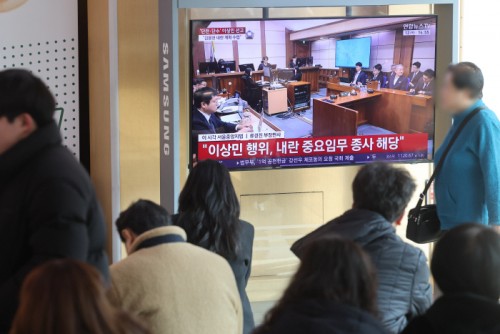 |
| Citizens watch live coverage of the first trial verdict of former Interior Minister Lee Sang-min at Seoul Station on Feb. 12. Lee was charged with participating in insurrection, including relaying orders to cut power and water supplies to media outlets during the Dec. 3 emergency martial law. / Yonhap News |
A South Korean court sentenced former Interior Minister Lee Sang-min to seven years in prison on Feb. 12, finding him guilty of participating in an insurrection during the Dec. 3 emergency martial law crisis.
The ruling follows a previous guilty verdict against former Prime Minister Han Duck-soo and reinforces the judiciary’s stance that the martial law declaration constituted “insurrection” under criminal law. Legal experts say the decision may influence the upcoming Feb. 19 verdict in the case of former President Yoon Suk Yeol.
The Criminal Division 32 of the Seoul Central District Court handed down the seven-year sentence, finding Lee guilty of playing a key role in the alleged insurrection.
The court ruled that the emergency martial law declaration amounted to insurrection and described former President Yoon and former Defense Minister Kim Yong-hyun as members of an “insurrection group.” Judges found that Lee received documents from Yoon outlining plans to block major institutions and cut electricity and water supplies to specific media outlets, and that he relayed those instructions to the National Fire Agency for implementation.
“The insurrection committed by the defendant and others ignored the legitimate procedures envisioned by the Constitution,” the court said. “By attempting to paralyze the functions of state institutions, including the National Assembly, through violent means, they fundamentally undermined the core values of democracy.”
The court added that insurrection threatening the existence of the state warrants severe punishment regardless of whether its objectives were achieved.
Lee was also found guilty of giving false testimony during last February’s impeachment trial of former President Yoon at the Constitutional Court of Korea, where he denied issuing or receiving any orders related to cutting power and water supplies. However, he was acquitted of abuse of authority charges related to instructing the Fire Agency to prepare for immediate response to police requests.
In a related case the same day, the Criminal Division 3 of the Seoul High Court upheld a two-year prison sentence and a forfeiture of 24.9 million won for former intelligence commander Roh Sang-won, who was convicted of violating the Personal Information Protection Act by obtaining information on military personnel in connection with investigations into alleged election fraud following the martial law declaration.
The appellate court stated that preparing troop mobilization plans and detailed missions under the assumption of martial law, despite the absence of wartime or national emergency conditions, constituted an unconstitutional and unlawful act in itself.
Separately, the same court sentenced broker Lee Sung-jae to three years in prison for taking hundreds of millions of won in exchange for promising an acquittal through an intermediary linked to a self-proclaimed shaman.
#Lee Sang-min #Han Duck-soo #Yoon Suk Yeol #Kim Yong-hyun
Copyright by Asiatoday
Most Read
-
1
Celltrion’s Omlyclo gains ground in major European..

-
2
Trump demands rates fall below 1% as Fed hikes for..

-
3
Hyundai Motor Group breaks ground on integrated st..

-
4
U.S. strikes 3 Iranian oil tankers, Iran vows reta..

-
5
Trump makes $1 trillion bet ahead of midterm elect..

-
6
Iran resumes ballistic missile production, assembl..

-
7
Samsung Electronics, Mistral AI to jointly develop..

PEOPLE






-
Address : In-Young Bldg., 34, Uisadang-daero 1-gil, Yeongdeungpo-gu, Seoul
Copyright by ASIATODAY CO., LTD. All rights resereved