



KDI raises Korea growth outlook to 1.9%
Feb 12, 2026, 08:17 am


 |
| Data = Korea Development Institute (KDI) / Graphic by Park Jong-gyu |
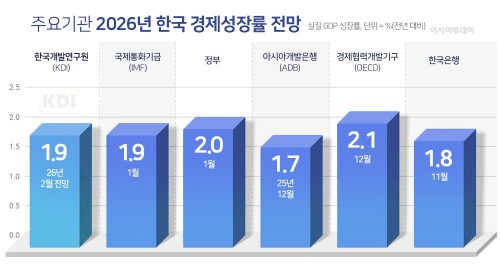
The Korea Development Institute (KDI) has raised its forecast for South Korea’s economic growth this year to 1.9 percent, citing robust exports driven by a global semiconductor supercycle.
In its revised February 2026 economic outlook released on Feb. 11, KDI upgraded the projection by 0.1 percentage point from the 1.8 percent forecast issued in November last year. The new estimate is slightly below the government’s 2.0 percent forecast but higher than the Bank of Korea’s 1.8 percent projection.
The upward revision comes as the domestic economy, which grew by just 1 percent last year, is expected to nearly double that pace in 2026. Increased investment in artificial intelligence technologies has fueled demand for semiconductors, boosting exports.
According to January trade data from the Ministry of Trade, Industry and Energy, exports rose 33.9 percent year-on-year to $65.85 billion, marking the highest January figure on record. Semiconductor exports jumped 102.7 percent from a year earlier to $20.54 billion, surpassing the $20 billion mark for the second consecutive month following December’s $20.8 billion.
Global investment banks have also taken note of the chip export surge, raising their forecasts for Korea’s growth. As of late January, the average growth estimate from eight major global investment banks stood at 2.1 percent, up 0.1 percentage point from the end of last year.
However, KDI warned that uncertainties surrounding U.S. tariff policies remain a downside risk.
“Uncertainty over U.S. reciprocal tariffs and potential tariffs on semiconductors and other electronic products remains high,” the institute said. “If higher tariffs are imposed, they could exert downward pressure on our exports.”
While the semiconductor upswing is providing near-term momentum, KDI cautioned that external trade risks could weigh on the sustainability of growth in the months ahead.
#Korea Development Institute #KDI #South Korea economy #economic growth forecast #semiconductor exports
Copyright by Asiatoday
Most Read
-
1
Celltrion’s Omlyclo gains ground in major European..

-
2
Trump demands rates fall below 1% as Fed hikes for..

-
3
Trump makes $1 trillion bet ahead of midterm elect..

-
4
Iran resumes ballistic missile production, assembl..

-
5
Trump warns countries not helping U.S. must pay re..

-
6
Apple launches first foldable, 1 million won prici..

-
7
Turkish Airlines named main club partner of Liverp..

PEOPLE







-
Address : In-Young Bldg., 34, Uisadang-daero 1-gil, Yeongdeungpo-gu, Seoul
Copyright by ASIATODAY CO., LTD. All rights resereved